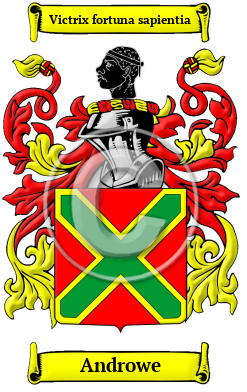
| ![Show Contents]() Androwe History, Family Crest & Coats of Arms Androwe History, Family Crest & Coats of Arms
Etymology of AndroweWhat does the name Androwe mean? The roots of the name Androwe are found among the Pictish clans of ancient Scotland. The name comes from the baptismal name Andrew which in Greek means manly. The name was popular as both a personal name and a surname, likely because it was the name of Scotland's patron saint. In Gaelic the name is Aindrea and Anndra which again means manly. Early Origins of the Androwe familyThe surname Androwe was first found in Caithness (Gaelic: Gallaibh), the northern tip of Scotland, a Norse/Viking controlled region from the 9th century, which became the Earldom of Caithness. This family was strongly associated with the Clan Ross. It was originally known as the Clan Siol Andrea, meaning the race of Andrew. However, from about the year 1100 the Andrews moved south to the Dumfriesshire area of southwest Scotland. Duncan Andrew, Chief of the Clan, rendered homage to King Edward I of England in 1296. 1 Some of the family were found further south in England, specifically at Shotley in Northumberland where "Shotley Hall is said to have been built by Dr. Andrews, physician to the first royal Duke of Cumberland." 2 Sir Edmund Andros (1637-1714) was born in London and rose to become an English colonial administrator in North America. The 1689 Boston revolt was directly attributed to his actions in New England. Early History of the Androwe familyThis web page shows only a small excerpt of our Androwe research. Another 86 words (6 lines of text) covering the years 1395, 1463, 1510, 1537, 1600, 1604, 1637, 1649, 1650, 1659, 1660, 1661, 1666, 1672, 1674, 1714, 1890 and 1958 are included under the topic Early Androwe History in all our PDF Extended History products and printed products wherever possible. Androwe Spelling VariationsAlthough Medieval Scotland lacked a basic set of spelling rules, which meant that scribes recorded names according to their sounds it was not uncommon for the names of a father and son to be recorded differently. As a result, there are many spelling variations of Scottish single names. Androwe has been written Andrew, Andrews, MacAndrew, Androw, Androe, Andro and many more. Early Notables of the Androwe familyAlexander Andrew, Sergeant of Aberdeen; Phineas Andrews (ca. 1600-1661), an English politician who sat in the House of Commons from 1660 to 1661; and Sir Thomas Andrewes (died 1659), English financier, supporter of the parliamentary cause during the English Civil War, Commissioner at the High Court of Justice for the trial of Charles I, Lord Mayor of London (1649-1650.)
Laurence Andrewe (fl. 1510-1537), was a French translator and printer, a native of Calais and Thomas Andrewe (fl. 1604), "was the author of a curious and somewhat...
Another 85 words (6 lines of text) are included under the topic Early Androwe Notables in all our PDF Extended History products and printed products wherever possible. Migration of the Androwe family to IrelandSome of the Androwe family moved to Ireland, but this topic is not covered in this excerpt.
Another 77 words (6 lines of text) about their life in Ireland is included in all our PDF Extended History products and printed products wherever possible.
| Androwe migration to the United States | + |
Thousands of Scots left their home country to travel to Ireland or Australia, or to cross the Atlantic for the North American colonies. The difficult crossing was an enormous hurdle, but those who survived found freedom and opportunity in ample measure. Some Scots even fought for their freedom in the American War of Independence. This century, their ancestors have become aware of the illustrious history of the Scots in North America and at home through Clan societies and other organizations. Passenger and immigration lists show many early and influential immigrants bearing the name Androwe:
Androwe Settlers in United States in the 17th Century- William Androwe, who settled in Virginia in 1635
| Androwe migration to West Indies | + |
The British first settled the British West Indies around 1604. They made many attempts but failed in some to establish settlements on the Islands including Saint Lucia and Grenada. By 1627 they had managed to establish settlements on St. Kitts (St. Christopher) and Barbados, but by 1641 the Spanish had moved in and destroyed some of these including those at Providence Island. The British continued to expand the settlements including setting the First Federation in the British West Indies by 1674; some of the islands include Barbados, Bermuda, Cayman Island, Turks and Caicos, Jamaica and Belize then known as British Honduras. By the 1960's many of the islands became independent after the West Indies Federation which existed from 1958 to 1962 failed due to internal political conflicts. After this a number of Eastern Caribbean islands formed a free association. 3Androwe Settlers in West Indies in the 17th Century- Mr. Owen Androwe, (b. 1617), aged 18, British settler travelling from London, England aboard the ship "Anne and Elizabeth" arriving in Barbados in 1635 4
The motto was originally a war cry or slogan. Mottoes first began to be shown with arms in the 14th and 15th centuries, but were not in general use until the 17th century. Thus the oldest coats of arms generally do not include a motto. Mottoes seldom form part of the grant of arms: Under most heraldic authorities, a motto is an optional component of the coat of arms, and can be added to or changed at will; many families have chosen not to display a motto.
Motto: Victrix fortuna sapientia
Motto Translation: Wisdom is the conqueror of fortune.
- Black, George F., The Surnames of Scotland Their Origin, Meaning and History. New York: New York Public Library, 1946. Print. (ISBN 0-87104-172-3)
- Lewis, Samuel, A Topographical Dictionary of England. Institute of Historical Research, 1848, Print.
- https://en.wikipedia.org/wiki/British_West_Indies
- Pilgrim Ship Lists Early 1600's. Retrieved 23rd September 2021 from https://www.packrat-pro.com/ships/shiplist.htm
 |