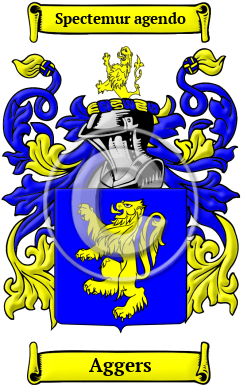
| ![Show Contents]() Aggers History, Family Crest & Coats of Arms Aggers History, Family Crest & Coats of Arms
Etymology of AggersWhat does the name Aggers mean? Aggers is an ancient Anglo-Saxon name that is derived from a group of baptismal surnames which all mean the son of Eggar or the son of Agar. "Probably a form of Algar, a Domesday personal name, and very popular for several centuries." 1 "Aighear signifies gladness, joy, gayety. If from the Latin ager, it denotes a field or land." 2 In Scotland, "Aeggar was king of the Scots a. 1189." 3 Early Origins of the Aggers familyThe surname Aggers was first found in the counties of Yorkshire and Northumberland, where they held a family seat from ancient times. "The Agars, an old York family of the 17th and 18th centuries, gained considerable estate by trade and founded a hospital in that city. Thomas Agar, tanner, was lord mayor of York in 1618, and the same office was filled by Thomas Agar, woollen draper, in 1724. Agar is still a York name." 4 Early History of the Aggers familyThis web page shows only a small excerpt of our Aggers research. Another 35 words (2 lines of text) covering the years 1672, 1703, 1713, 1714, 1715, 1727, 1733 and 1782 are included under the topic Early Aggers History in all our PDF Extended History products and printed products wherever possible. Aggers Spelling VariationsAggers has been spelled many different ways. Before English spelling became standardized over the last few hundred years, spelling variations in names were a common occurrence. As the English language changed in the Middle Ages, absorbing pieces of Latin and French, as well as other languages, the spelling of people's names also changed considerably, even over a single lifetime. Many variations of the name Aggers have been found, including Agar, Algar, Alger, Algore, Augar, Auger, Elger, Elgar, Eager, Eagar, Etches, Eaches and many more. Early Notables of the Aggers familyJohn Eager, born 1782 at Norwich, where his father was a musical instrument maker and organ builder. Having learned from his father the rudiments of music, he was at twelve years old taken under the care of the Duke of Dorset, an amateur violinist, who carried him to his seat at Knole, where free access to the library enabled him to repair the defects of his early education. His patron dying he established himself at Yarmouth as a...
Another 78 words (6 lines of text) are included under the topic Early Aggers Notables in all our PDF Extended History products and printed products wherever possible. Migration of the Aggers family to IrelandSome of the Aggers family moved to Ireland, but this topic is not covered in this excerpt.
Another 76 words (5 lines of text) about their life in Ireland is included in all our PDF Extended History products and printed products wherever possible.
| Aggers migration to New Zealand | + |
Emigration to New Zealand followed in the footsteps of the European explorers, such as Captain Cook (1769-70): first came sealers, whalers, missionaries, and traders. By 1838, the British New Zealand Company had begun buying land from the Maori tribes, and selling it to settlers, and, after the Treaty of Waitangi in 1840, many British families set out on the arduous six month journey from Britain to Aotearoa to start a new life. Early immigrants include: Aggers Settlers in New Zealand in the 19th Century- J Aggers, who landed in Auckland, New Zealand in 1845
The motto was originally a war cry or slogan. Mottoes first began to be shown with arms in the 14th and 15th centuries, but were not in general use until the 17th century. Thus the oldest coats of arms generally do not include a motto. Mottoes seldom form part of the grant of arms: Under most heraldic authorities, a motto is an optional component of the coat of arms, and can be added to or changed at will; many families have chosen not to display a motto.
Motto: Spectemur agendo
Motto Translation: Let us be judged by our actions.
- Bardsley, C.W, A Dictionary of English and Welsh Surnames: With Special American Instances. Wiltshire: Heraldry Today, 1901. Print. (ISBN 0-900455-44-6)
- Arthur, William , An Etymological Dictionary of Family and Christian Names. London: 1857. Print
- Black, George F., The Surnames of Scotland Their Origin, Meaning and History. New York: New York Public Library, 1946. Print. (ISBN 0-87104-172-3)
- Guppy, Henry Brougham, Homes of Family Names in Great Britain. 1890. Print.
 |