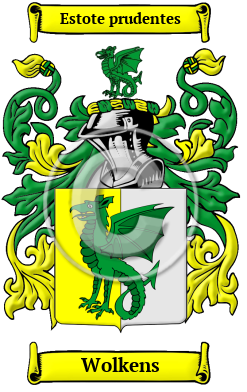
| ![Show Contents]() Wolkens History, Family Crest & Coats of Arms Wolkens History, Family Crest & Coats of Arms
- Origins Available:
England
Etymology of WolkensWhat does the name Wolkens mean? The name Wolkens reached English shores for the first time with the ancestors of the Wolkens family as they migrated following the Norman Conquest of 1066. The name Wolkens is based on the Norman personal name William, which is derived from the words will, meaning resolution and helm, meaning armed. 1 2 Early Origins of the Wolkens familyThe surname Wolkens was first found in Glamorganshire, Wales where they held a family seat from early times. They were descended from Robert de Wintona, one of twelve knights who came into Glamorgan with Robert Fitzhamon, a Norman noble, in 1066. Fitzhamon was Sheriff of Kent, England and founder of Tewkesbury. 3 The Pipe Rolls for Northumberland, England list the name Wilechm in 1166 and later Wilekinus was found in the Hampshire Pipe Rills for 1191. Richard Wilekin was found in the Pipe Rolls for Hampshire in 1180 and William Wilekin in the Curia Regis Rolls for London in 1220. Roger Wylkyns was listed in the Subsidy Rolls for Staffordshire in 1327. 4 Early History of the Wolkens familyThis web page shows only a small excerpt of our Wolkens research. Another 119 words (8 lines of text) covering the years 1558, 1601, 1603, 1614, 1618, 1625, 1626, 1668, 1672, 1685, 1699 and 1745 are included under the topic Early Wolkens History in all our PDF Extended History products and printed products wherever possible. Wolkens Spelling VariationsThe English language only became standardized in the last few centuries. For that reason, spelling variations are common among many Anglo-Norman names. The shape of the English language was frequently changed with the introduction of elements of Norman French, Latin, and other European languages; even the spelling of literate people's names were subsequently modified. Wolkens has been recorded under many different variations, including Wilkins, Wilkin, Wilkines, Wilkyn, Wilking and others. Early Notables of the Wolkens familyJohn Wilkins FRS (1614-1672), an English clergyman, natural philosopher and author, founder of the Invisible College and one of the founders of the Royal Society, Bishop of Chester from 1668 until his death.
Thomas Wilkins (1625 or 1626-1699), was a Welsh cleric and antiquarian; and George Wilkins (died 1618), was an English dramatist and pamphleteer best known for his probable collaboration with Shakespeare on the play Pericles, Prince of Tyre. An inn-keeper by profession, he may have been involved in criminal activities.
David Wilkins (1685-1745), was an English scholar, born of Prussian parentage. His true name...
Another 93 words (7 lines of text) are included under the topic Early Wolkens Notables in all our PDF Extended History products and printed products wherever possible. Migration of the Wolkens familyTo escape the uncertainty of the political and religious uncertainty found in England, many English families boarded ships at great expense to sail for the colonies held by Britain. The passages were expensive, though, and the boats were unsafe, overcrowded, and ridden with disease. Those who were hardy and lucky enough to make the passage intact were rewarded with land, opportunity, and social environment less prone to religious and political persecution. Many of these families went on to be important contributors to the young nations of Canada and the United States where they settled. Wolkenss were some of the first of the immigrants to arrive in North America: Nicholas Wilking, a juror of St. John's, Newfoundland in 1753; Maudlin Wilkin settled in Barbados in 1654; Bridget and John Wilkines settled in Virginia in 1623.
The motto was originally a war cry or slogan. Mottoes first began to be shown with arms in the 14th and 15th centuries, but were not in general use until the 17th century. Thus the oldest coats of arms generally do not include a motto. Mottoes seldom form part of the grant of arms: Under most heraldic authorities, a motto is an optional component of the coat of arms, and can be added to or changed at will; many families have chosen not to display a motto.
Motto: Estote prudentes
Motto Translation: Be ye prudent.
- Smith, Eldson Coles, New Dictionary of American Family Names New York: Harper & Row, 1956. Print
- Arthur, William , An Etymological Dictionary of Family and Christian Names. London: 1857. Print
- Williams, Dr Ann. And G.H. Martin, Eds., Domesday Book A Complete Translation. London: Penguin, 1992. Print. (ISBN 0-141-00523-8)
- Reaney, P.H and R.M. Wilson, A Dictionary of English Surnames. London: Routledge, 1991. Print. (ISBN 0-415-05737-X)
 |