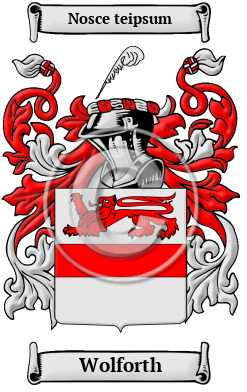
| ![Show Contents]() Wolforth History, Family Crest & Coats of Arms Wolforth History, Family Crest & Coats of Arms
- Origins Available:
England
Etymology of WolforthWhat does the name Wolforth mean? Wolforth is a name of ancient Anglo-Saxon origin and comes from the family once having lived in one of the settlements called Walford in Dorset, Herefordshire, or Shropshire, or in Walford Hall in Warwickshire. 1 "The Somerset Walford occurs as Weala-ford in a charter dated A.D. 682 while the Herefordshire place is Walforde in Domesday Book, and the Shropshire township Waleford and Waliforde in Domesday Book." 2 Another source notes the Herefordshire and Worcestershire place names were recorded as Walorecford in the Domesday Book of 1086. 3 As far as the etymology of the place names are concerned, one source claims the place names mean "Briton ford," 4 while another claims the place names mean "the Welshmen’s Ford [Old English Weála, genit. pl. of Weal(h, a Welshman + ford]". 2 Early Origins of the Wolforth familyThe surname Wolforth was first found in Warwickshire where William de Waleford listed in the Assize Rolls of 1221. Over in Gloucestershire, Henry de Walford was listed there in 1279 and in Somerset, Gilbert Walford was listed there in the Subsidy Rolls of 1327. 5 Ricardus de Walleford was listed in the Charter Rolls for Shropshire (Salop), 1316-1317. 2 Early History of the Wolforth familyThis web page shows only a small excerpt of our Wolforth research. Another 138 words (10 lines of text) covering the years 1572, 1663, 1672, 1752, 1756, 1777, 1778, 1787, 1797, 1823, 1833, 1855 and 1897 are included under the topic Early Wolforth History in all our PDF Extended History products and printed products wherever possible. Wolforth Spelling VariationsSound was what guided spelling in the essentially pre-literate Middle Ages, so one person's name was often recorded under several variations during a single lifetime. Also, before the advent of the printing press and the first dictionaries, the English language was not standardized. Therefore, spelling variations were common, even among the names of the most literate people. Known variations of the Wolforth family name include Walford, Wallford and others. Early Notables of the Wolforth familyThomas Walford (1752-1833) was an English antiquary. Born on 14 September 1752, he was the only son of Thomas Walford (d. 1756) of Whitley, near Birdbrook in Essex. He was an officer in the Essex militia in 1777, and was appointed deputy lieutenant of the county in 1778. In March 1797 he was nominated captain in the provisional cavalry, and in May following was gazetted major. Walford died at Whitley on...
Another 71 words (5 lines of text) are included under the topic Early Wolforth Notables in all our PDF Extended History products and printed products wherever possible. Migration of the Wolforth familyFor political, religious, and economic reasons, thousands of English families boarded ships for Ireland, Canada, the America colonies, and many of smaller tropical colonies in the hope of finding better lives abroad. Although the passage on the cramped, dank ships caused many to arrive in the New World diseased and starving, those families that survived the trip often went on to make valuable contributions to those new societies to which they arrived. Early immigrants bearing the Wolforth surname or a spelling variation of the name include: Thomas and Jeremiah Walford who settled in Charles Town Massachusetts in 1630; Muse Walford settled in Barbados with his wife, four children, and servants, in 1678.
The motto was originally a war cry or slogan. Mottoes first began to be shown with arms in the 14th and 15th centuries, but were not in general use until the 17th century. Thus the oldest coats of arms generally do not include a motto. Mottoes seldom form part of the grant of arms: Under most heraldic authorities, a motto is an optional component of the coat of arms, and can be added to or changed at will; many families have chosen not to display a motto.
Motto: Nosce teipsum
Motto Translation: Know thyself.
- Bardsley, C.W, A Dictionary of English and Welsh Surnames: With Special American Instances. Wiltshire: Heraldry Today, 1901. Print. (ISBN 0-900455-44-6)
- Harrison, Henry, Surnames of the United Kingdom: A Concise Etymological Dictionary Baltimore: Geneological Publishing Company, 2013. Print
- Williams, Dr Ann. And G.H. Martin, Eds., Domesday Book A Complete Translation. London: Penguin, 1992. Print. (ISBN 0-141-00523-8)
- Mills, A.D., Dictionary of English Place-Names. Oxford: Oxford University Press, 1991. Print. (ISBN 0-19-869156-4)
- Reaney, P.H and R.M. Wilson, A Dictionary of English Surnames. London: Routledge, 1991. Print. (ISBN 0-415-05737-X)
 |