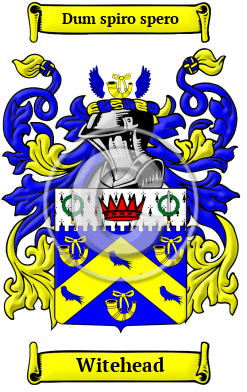
| ![Show Contents]() Witehead History, Family Crest & Coats of Arms Witehead History, Family Crest & Coats of Arms
Etymology of WiteheadWhat does the name Witehead mean? The ancient Anglo-Saxon culture of England produced the name of Witehead. It was given to a whitehaired or fair-haired person. The surname Witehead is derived from the Old English words hwit, which means white, and heafod, which means head. 1 Early Origins of the Witehead familyThe surname Witehead was first found in Lancashire and "especially in North England. " 2 The Hundredorum Rolls of 1273 included two entries for the family with very early spellings: Roger Witheyed, Huntingdonshire; and William Witheyed, Cambridgeshire. And in Yorkshire, the Yorkshire Poll Tax Rolls of 1379 listed Adam Whiteheued; Johannes Whittehed; and Robertus Qwytheued. 2 Further to the north in Scotland, the first record of the family was "Adam Whytehevde de Hoton, juror on inquisition before the sheriff of Berwick, 1300. " 3 Early History of the Witehead familyThis web page shows only a small excerpt of our Witehead research. Another 121 words (9 lines of text) covering the years 1300, 1423, 1485, 1492, 1519, 1523, 1540, 1541, 1551, 1557, 1571, 1585, 1594, 1609, 1625, 1628, 1629, 1630, 1636, 1653, 1660, 1661, 1663, 1672, 1684, 1696 and 1723 are included under the topic Early Witehead History in all our PDF Extended History products and printed products wherever possible. Witehead Spelling VariationsOne relatively recent invention that did much to standardize English spelling was the printing press. However, before its invention even the most literate people recorded their names according to sound rather than spelling. The spelling variations under which the name Witehead has appeared include Whitehedd, Whited, Whitehead, Whytehead and others. Early Notables of the Witehead familyDavid Whithead (1492?-1571), English divine, born about 1492, a native of Hampshire (Wood), where the Whiteheads had some landed property. "His contemporary, Hugh Whitehead (d. 1551), with whom David has been confused, belonged to a Durham branch of the family, was from 1519 to 1540 last prior, and from 1541 first dean of Durham. " 4
George Whitehead (1636?-1723), was an English Quaker, born at Sun Bigs, parish of Orton, Westmorland. From 1661 to 1672 Whitehead spent most of his time in prison. He died on 8 March 1723, in his eighty-seventh year, and was buried in the Quakers' burial-ground...
Another 98 words (7 lines of text) are included under the topic Early Witehead Notables in all our PDF Extended History products and printed products wherever possible. Migration of the Witehead family to IrelandSome of the Witehead family moved to Ireland, but this topic is not covered in this excerpt.
Another 32 words (2 lines of text) about their life in Ireland is included in all our PDF Extended History products and printed products wherever possible. Migration of the Witehead familyAt this time, the shores of the New World beckoned many English families that felt that the social climate in England was oppressive and lacked opportunity for change. Thousands left England at great expense in ships that were overcrowded and full of disease. A great portion of these settlers never survived the journey and even a greater number arrived sick, starving, and without a penny. The survivors, however, were often greeted with greater opportunity than they could have experienced back home. These English settlers made significant contributions to those colonies that would eventually become the United States and Canada. An examination of early immigration records and passenger ship lists revealed that people bearing the name Witehead arrived in North America very early: Daniel Whitehead settled at Hempstead in New York in 1631; Richard Whitehead settled in New England in 1630; John Whitehead settled in New Haven Conn. in 1630.
The motto was originally a war cry or slogan. Mottoes first began to be shown with arms in the 14th and 15th centuries, but were not in general use until the 17th century. Thus the oldest coats of arms generally do not include a motto. Mottoes seldom form part of the grant of arms: Under most heraldic authorities, a motto is an optional component of the coat of arms, and can be added to or changed at will; many families have chosen not to display a motto.
Motto: Dum spiro spero
Motto Translation: While I have breath I hope.
- Lower, Mark Anthony, Patronymica Britannica, A Dictionary of Family Names of the United Kingdom. London: John Russel Smith, 1860. Print.
- Bardsley, C.W, A Dictionary of English and Welsh Surnames: With Special American Instances. Wiltshire: Heraldry Today, 1901. Print. (ISBN 0-900455-44-6)
- Black, George F., The Surnames of Scotland Their Origin, Meaning and History. New York: New York Public Library, 1946. Print. (ISBN 0-87104-172-3)
- Smith, George (ed), Dictionary of National Biography. London: Smith, Elder & Co., 1885-1900. Print
 |