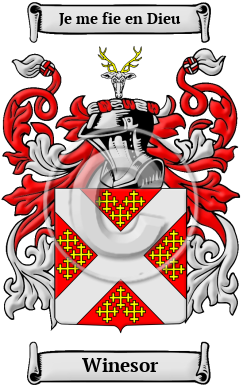
| ![Show Contents]() Winesor History, Family Crest & Coats of Arms Winesor History, Family Crest & Coats of Arms
Etymology of WinesorWhat does the name Winesor mean? The name Winesor reached England in the great wave of migration following the Norman Conquest of 1066. The Winesor family lived in Berkshire, at Windsor Castle. Interestingly, "The Stanwell family claim descent from Walter Fitz-Other (fl. 1087), who held that manor at the time of Domesday Book and was warder of Windsor Castle, whence he derived the name Windsor. His third son, Gerald de Windsor (fl. 1116), was constable of Pembroke Castle, and steward to Arnulf, Earl of Pembroke, in whose service he saw much fighting in Pembroke. He was sent to King Murtagh in Ireland to ask his daughter's hand for Arnulf, married Nest or Nesta, mistress of Henry I, and was father of William Fitzgerald, Maurice Fitzgerald (d. 1176), David (d. 1176), Bishop of St. David's, and Angharad, mother of Giraldus Cambrensis, the historian. It was from Gerald's eldest brother William that the Windsors of Stanwell claimed descent." 1 Early Origins of the Winesor familyThe surname Winesor was first found in Berkshire, where they were descended from William FitzOtho, who was son of Adalbert the second Duke of Lombardy. This Walter was given Windsor Castle by William, Duke of Normandy. His son, William Fitzwalter assumed the surname of the Castle. This was not the only time a family would assume the name of the castle as in 1917, the present Royal family would do the same. One of the first on records of the family was Sir William de Windsor, Baron Windsor (d. 1384), Deputy of Ireland, the son of Sir Alexander de Windsor of Grayrigg, Westmorland. "No connection has been proved between this family and that of the Windsors of Stanwell. " 1 Early History of the Winesor familyThis web page shows only a small excerpt of our Winesor research. Another 128 words (9 lines of text) covering the years 1178, 1360, 1381, 1445, 1467, 1513, 1541, 1543, 1624, 1627, 1687 and 1917 are included under the topic Early Winesor History in all our PDF Extended History products and printed products wherever possible. Winesor Spelling VariationsBefore the advent of the printing press and the first dictionaries, the English language was not standardized. Sound was what guided spelling in the Middle Ages, so one person's name was often recorded under several variations during a single lifetime. Spelling variations were common, even among the names of the most literate people. Known variations of the Winesor family name include Windsor, Winsor, Winzer, Winser, Wincer and others. Early Notables of the Winesor familySir James Windsor (c.1360), ancestor of the Earls of Plymouth, First Baron Andrew Windsor (1467-1543), a courtier and army commander, and Miles Windsore (1541-1624), a British scholar and poet.
Thomas Windsor, seventh Baron Windsor of Stanwell and first Earl of Plymouth (1627?-1687), born about 1627...
Another 43 words (3 lines of text) are included under the topic Early Winesor Notables in all our PDF Extended History products and printed products wherever possible. Migration of the Winesor family to IrelandSome of the Winesor family moved to Ireland, but this topic is not covered in this excerpt.
Another 39 words (3 lines of text) about their life in Ireland is included in all our PDF Extended History products and printed products wherever possible. Migration of the Winesor familyTo escape the political and religious chaos of this era, thousands of English families began to migrate to the New World in search of land and freedom from religious and political persecution. The passage was expensive and the ships were dark, crowded, and unsafe; however, those who made the voyage safely were encountered opportunities that were not available to them in their homeland. Many of the families that reached the New World at this time went on to make important contributions to the emerging nations of the United States and Canada. Research into various historical records has revealed some of first members of the Winesor family to immigrate North America: Robert Windsor, who came to Boston in 1631; Joshua Windsor, who arrived in Providence, Rhode Island in 1638; Marthah Windsor, who came to Nevis in 1660.
The motto was originally a war cry or slogan. Mottoes first began to be shown with arms in the 14th and 15th centuries, but were not in general use until the 17th century. Thus the oldest coats of arms generally do not include a motto. Mottoes seldom form part of the grant of arms: Under most heraldic authorities, a motto is an optional component of the coat of arms, and can be added to or changed at will; many families have chosen not to display a motto.
Motto: Je me fie en Dieu
Motto Translation: I trust in God.
- Smith, George (ed), Dictionary of National Biography. London: Smith, Elder & Co., 1885-1900. Print
 |