
Show ContentsWebbar History, Family Crest & Coats of Arms

Etymology of Webbar

What does the name Webbar mean?

The distinguished surname Webbar emerged among the industrious people of Flanders, which was an important trading partner and political ally of Britain during the Middle Ages. As a result of the frequent commercial intercourse between the Flemish and English nations, many Flemish migrants settled in Britain. In early times, people were known by only a single name. However, as the population grew and people traveled further afield, it became increasingly necessary to assume an additional name to differentiate between bearers of the same personal name. Occupational surnames were derived from the common trades of the medieval era. The surname Webbar is an occupational name for a person who made his living as a weaver of cloth. The surname Webbar is a derivative of the Old English word web, which means web or weaver.

Early Origins of the Webbar family

The surname Webbar was first found in Somerset where they were one of the many Flemish industrialist families who settled in the west country in the 13th century. John le Webber was listed in the Feet of Fines of Essex in 1255; and later Hugo le Webbere was listed in the Subsidy Rolls of Staffordshire in 1327. 1 The Calendarium Inquisitionum Post Mortem listed: Robert le Webber; and Clarice le Webbere. 2

Early History of the Webbar family

This web page shows only a small excerpt of our Webbar research. Another 63 words (4 lines of text) covering the years 1751 and 1793 are included under the topic Early Webbar History in all our PDF Extended History products and printed products wherever possible.

Webbar Spelling Variations

Flemish surnames are characterized by a large number of spelling variations. One reason for this is that medieval English lacked definite spelling rules. The spellings of surnames were also influenced by the official court languages, which were French and Latin. Names were rarely spelled consistently in medieval times. Scribes and church officials recorded names as they sounded, rather than adhering to specific spelling rules, and people often had their names registered in several different forms throughout their lives. One of the greatest reasons for change is the linguistic uniqueness of the Flemish settlers in England, who spoke a language closely related to Dutch. The pronunciation and spelling of Flemish names were often altered to suit the tastes of English-speaking people. In many cases, the first, final, or middle syllables of surnames were eliminated. The name has been spelled Webber, Weber and others.

Early Notables of the Webbar family

Another 48 words (3 lines of text) are included under the topic Early Webbar Notables in all our PDF Extended History products and printed products wherever possible.

Migration of the Webbar family to Ireland

Some of the Webbar family moved to Ireland, but this topic is not covered in this excerpt. More information about their life in Ireland is included in all our PDF Extended History products and printed products wherever possible.

Migration of the Webbar family

Investigation of immigration and passenger lists has revealed a number of people bearing the name Webbar: Thomas Webber who settled in Maine in 1616; four years before the "Mayflower"; Henry Webber of Harbour Grace, Newfoundland, in 1782; claims that the property had been in possession of the family for 105 years, 1677.


The Webbar Motto +

The motto was originally a war cry or slogan. Mottoes first began to be shown with arms in the 14th and 15th centuries, but were not in general use until the 17th century. Thus the oldest coats of arms generally do not include a motto. Mottoes seldom form part of the grant of arms: Under most heraldic authorities, a motto is an optional component of the coat of arms, and can be added to or changed at will; many families have chosen not to display a motto.

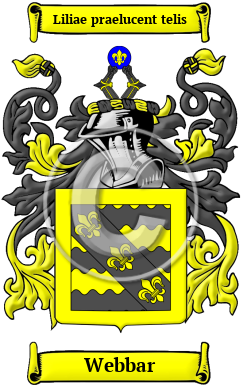
Motto: Liliae praelucent telis
Motto Translation: Lillies outshine weapons of war.


  1. Reaney, P.H and R.M. Wilson, A Dictionary of English Surnames. London: Routledge, 1991. Print. (ISBN 0-415-05737-X)
  2. Bardsley, C.W, A Dictionary of English and Welsh Surnames: With Special American Instances. Wiltshire: Heraldry Today, 1901. Print. (ISBN 0-900455-44-6)


Houseofnames.com on Facebook