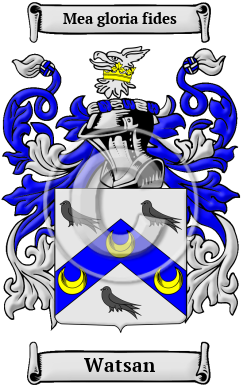
| ![Show Contents]() Watsan History, Family Crest & Coats of Arms Watsan History, Family Crest & Coats of Arms
Etymology of WatsanWhat does the name Watsan mean? The ancient Anglo-Saxon surname Watsan came from Wat, which is a diminutive form of Walter. This Old German name, which literally means mighty army, was introduced into England during the reign of Edward the Confessor and became one of the most popular personal names in that country following the Norman Conquest of 1066. The surname also features the suffix -son, which superseded other patronymic suffixes in popularity during the 14th century and was most popular in the north of England. Early Origins of the Watsan familyThe surname Watsan was first found in the county of Rutland, where they were Lords of the manor of Rockingham, from ancient times. This was home to "a castle was erected by William I., on the summit of a hill, for the protection of the extensive iron-works at that time carried on in the adjacent woodlands. During the war in the reign of Charles I., the castle was garrisoned for the king by Sir Lewis Watson, afterwards created Lord Rockingham, and was besieged by the parliamentarian forces, who at the same time destroyed the tower and part of the nave of the church: the only remains of the castle are the two massive bastions that defended the entrance gateway." 1 Early History of the Watsan familyThis web page shows only a small excerpt of our Watsan research. Another 136 words (10 lines of text) covering the years 1392, 1450, 1493, 1593, 1600, 1601, 1617, 1620, 1630, 1637, 1659, 1660, 1683, 1685, 1686, 1687, 1699, 1710, 1717, 1722 and 1890 are included under the topic Early Watsan History in all our PDF Extended History products and printed products wherever possible. Watsan Spelling VariationsSound was what guided spelling in the essentially pre-literate Middle Ages, so one person's name was often recorded under several variations during a single lifetime. Also, before the advent of the printing press and the first dictionaries, the English language was not standardized. Therefore, spelling variations were common, even among the names of the most literate people. Known variations of the Watsan family name include Wattson, Walterson, MacWattie and others. Early Notables of the Watsan familyEarl of Rockingham; Thomas Watson (c. 1620-1686), an English, Nonconformist, Puritan preacher and author; Daniel Watson (c 1617-1683), an English lawyer and politician, Member of Parliament for Lichfield in 1659, Recorder of Newcastle-under-Lyme (1660-1683); Thomas Watson (1637-1717), an English clergyman, Bishop of St David's (1687-1699); Samuel Watson (fl. c.1687-c.1710), an associate of Isaac Newton, he invented the 5 minute repeater, made the first stopwatch and a clock for King Charles II; and Edward Watson, Viscount Sondes (1686-1722), a British Member of Parliament.
Anthony Wadeson (fl. 1600), English playwright...
Another 86 words (6 lines of text) are included under the topic Early Watsan Notables in all our PDF Extended History products and printed products wherever possible. Migration of the Watsan family to IrelandSome of the Watsan family moved to Ireland, but this topic is not covered in this excerpt.
Another 90 words (6 lines of text) about their life in Ireland is included in all our PDF Extended History products and printed products wherever possible.
| Watsan migration to Australia | + |
Emigration to Australia included the Third Fleet of convicts, tradespeople and early settlers. Early immigrants include: Third Fleet - Mr. John Watson, (b. 1753), aged 34, English settler convicted in Maidstone, Kent on 13th March 1786, sentenced for 7 years for theft, transported aboard the ship "Alexander" leaving in 1787 arriving in New South Wales, Australia in 1788 2
The motto was originally a war cry or slogan. Mottoes first began to be shown with arms in the 14th and 15th centuries, but were not in general use until the 17th century. Thus the oldest coats of arms generally do not include a motto. Mottoes seldom form part of the grant of arms: Under most heraldic authorities, a motto is an optional component of the coat of arms, and can be added to or changed at will; many families have chosen not to display a motto.
Motto: Mea gloria fides
Motto Translation: Fidelity is my glory.
- Lewis, Samuel, A Topographical Dictionary of England. Institute of Historical Research, 1848, Print.
- Convict Records of Australia. Retrieved 4th February 2021 from https://convictrecords.com.au/ships
 |