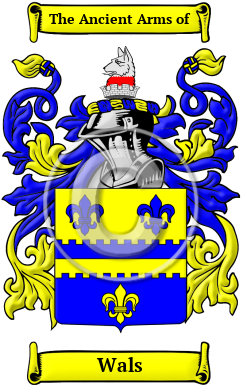
| ![Show Contents]() Wals History, Family Crest & Coats of Arms Wals History, Family Crest & Coats of Arms
Etymology of WalsWhat does the name Wals mean? The history of the Wals family goes back to the ancient Anglo-Saxon culture of Britain. It is derived from the family living near a stone-built wall. Wals is a local surname, which belongs to the category of hereditary surnames. Other types of local surnames include topographic surnames, which could be given to a person who lived beside any physical feature, such as a hill, stream, church or type of tree. Habitation names form the other broad category of surnames that were derived from place-names. They were derived from pre-existing names for towns, villages, parishes, or farmsteads. Other local names are derived from the names of houses, manors, estates, regions, and entire counties. The surname Wals referred to a person who lived beside a large stone wall, which was used either for the purpose of fortification, or to keep back the encroachment of the sea. Members of the Wals family were established in Gloucestershire prior to the Norman Conquest of England, in 1066. By the time of the Conquest, they were major landholders in that county. Early Origins of the Wals familyThe surname Wals was first found in Gloucestershire where they held a family seat from very ancient times and appeared as holders of lands in the Domesday Book compiled in 1086 by King William of England. The name was from the Anglo-Saxon Wal, meaning a stranger. Wales is a parish, in the union of Worksop, S. division of the wapentake of Strafforth and Tickhill in the West Riding of Yorkshire. "This parish, in the Domesday Survey called Walise, belonged to Morcar, Earl of Northumberland, in the reign of Edward the Confessor." 1 Early History of the Wals familyThis web page shows only a small excerpt of our Wals research. Another 134 words (10 lines of text) covering the years 1172, 1210, 1303, 1352, 1588, 1620, 1647, 1666, 1679, 1728, 1760, 1789 and 1890 are included under the topic Early Wals History in all our PDF Extended History products and printed products wherever possible. Wals Spelling VariationsUntil quite recently, the English language has lacked a definite system of spelling rules. Consequently, Anglo-Saxon surnames are characterized by a multitude of spelling variations. Changes in Anglo-Saxon names were influenced by the evolution of the English language, as it incorporated elements of French, Latin, and other languages. Although Medieval scribes and church officials recorded names as they sounded, so it is common to find one person referred to by several different spellings of his surname, even the most literate people varied the spelling of their own names. Variations of the name Wals include Wall, Walls, Wale, Walles and others. Early Notables of the Wals familySir Thomas Wale (1303-1352), an English soldier and co-founder of the Knight of the Garter; William de Wall, the knight who accompanied Strongbow; Saint John Wall, O.F.M., (1620-1679), an English Catholic Franciscan friar, apprehended under suspicion of being a party to the Titus Oates plot, was executed and later honored as a martyr; William Wall (1647-1728)...
Another 55 words (4 lines of text) are included under the topic Early Wals Notables in all our PDF Extended History products and printed products wherever possible. Migration of the Wals family to IrelandSome of the Wals family moved to Ireland, but this topic is not covered in this excerpt.
Another 80 words (6 lines of text) about their life in Ireland is included in all our PDF Extended History products and printed products wherever possible. Migration of the Wals familySearching for a better life, many English families migrated to British colonies. Unfortunately, the majority of them traveled under extremely harsh conditions: overcrowding on the ships caused the majority of the immigrants to arrive diseased, famished, and destitute from the long journey across the ocean. For those families that arrived safely, modest prosperity was attainable, and many went on to make invaluable contributions to the development of the cultures of the new colonies. Research into the origins of individual families in North America revealed records of the immigration of a number of people bearing the name Wals or a variant listed above: John Walls, a servant, who settled in Argentia, Newfoundland in 1773; Phillip Walls was a fisherman of Petty Harbour, Newfoundland in 1745; William Walls settled in Annapolis Maryland in 1758.
- Lewis, Samuel, A Topographical Dictionary of England. Institute of Historical Research, 1848, Print.
 |