| ![Show Contents]() Waddel History, Family Crest & Coats of Arms Waddel History, Family Crest & Coats of Arms
Etymology of WaddelWhat does the name Waddel mean? The surname Waddel comes from the place named Wedale, in the parish of Stow, near Edinburgh. As such it is a habitation name, a category of surnames derived from pre-existing names for towns, villages, parishes, or farmsteads. Early Origins of the Waddel familyThe surname Waddel was first found in Midlothian, where they had held territories at Wedale in the parish of Stow from ancient times. 1 Most sources agree in this origin, but one claims the name was English having derived from Odell, a parish in Bedfordshire. "For proof, v. Odell. Waddle is a natural variant, but seems confined to America." 2 This researcher noted that the Hundredorum Rolls of 1273 included a listing for Robert de Wadhulle, Bedfordshire. But let's return to Scotland where the lion's share of the family claim descent. "The earliest known bearer of the name is Adam de Wedale, 'an outlaw of the King of Scots land,' who appears in 1204. Stephen de Wee ale witnessed a charter of the lands of Swaynystoun to the Hospital of Soltre, c. 1221-24, and Thomas de Wedal was canon of St. Andrews 1280. Laurence de Wedale of Roxburghshire rendered homage in 1296. His seal bears an eight-rayed figure and S' Lavrenci d' Vedal" 3 On this last entry, we must explain the significance of "rendered homage in 1296." King Edward I of England conquered much of lowland Scotland in 1296 and confiscated the lands. To retrieve your lands, you had to "render homage" to him, thereby acknowledging him as the rightful king. "Symone de Wedale, [was] abbot of Holyrood, Edinburgh, between 1296-1327, as Symon de Wedehale was consecrated bishop of Galloway in 1327. Adam de Wedale, monk of Newbotyl, was witness in proceedings against the Knights Templars in 1309, and Roger de Wedale was canon of Dunblane, 1312, and in 1321 prebendary of Murthlach." 3 Early History of the Waddel familyThis web page shows only a small excerpt of our Waddel research. Another 330 words (24 lines of text) covering the years 1344, 1359, 1370, 1372, 1395, 1400, 1405, 1421, 1424, 1505, 1555, 1557, 1567, 1583, 1600, 1610, 1613, 1617, 1621, 1642, 1672, 1682, 1725, 1793 and 1890 are included under the topic Early Waddel History in all our PDF Extended History products and printed products wherever possible. Waddel Spelling VariationsSpelling variations of this family name include: Waddel, Waddell, Waddle, Weddel, Weddell, Weddle and many more. Early Notables of the Waddel familyJohn Weddell (1583-1642), sea-captain who in 1617 was master's mate of the East India Company's ship Dragon. "In April 1621 he sailed from England as captain of the Jonas, with three other ships under his orders. At the Cape of...
Another 40 words (3 lines of text) are included under the topic Early Waddel Notables in all our PDF Extended History products and printed products wherever possible. Migration of the Waddel family to IrelandSome of the Waddel family moved to Ireland, but this topic is not covered in this excerpt.
Another 51 words (4 lines of text) about their life in Ireland is included in all our PDF Extended History products and printed products wherever possible.
| Waddel migration to the United States | + |
Waddel Settlers in United States in the 18th Century- James Waddel, who settled in Maine in 1745
Waddel Settlers in United States in the 19th Century- Ralph Waddel, who settled in New York in 1811
- Ralph Waddel, who arrived in New York, NY in 1811 4
| Waddel migration to New Zealand | + |
Emigration to New Zealand followed in the footsteps of the European explorers, such as Captain Cook (1769-70): first came sealers, whalers, missionaries, and traders. By 1838, the British New Zealand Company had begun buying land from the Maori tribes, and selling it to settlers, and, after the Treaty of Waitangi in 1840, many British families set out on the arduous six month journey from Britain to Aotearoa to start a new life. Early immigrants include: Waddel Settlers in New Zealand in the 19th Century- John Waddel, who landed in Auckland, New Zealand in 1843
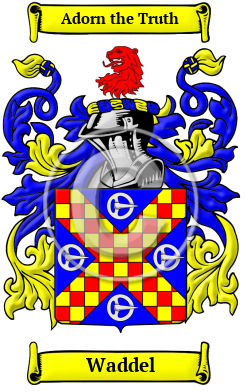
The motto was originally a war cry or slogan. Mottoes first began to be shown with arms in the 14th and 15th centuries, but were not in general use until the 17th century. Thus the oldest coats of arms generally do not include a motto. Mottoes seldom form part of the grant of arms: Under most heraldic authorities, a motto is an optional component of the coat of arms, and can be added to or changed at will; many families have chosen not to display a motto.
Motto: Adorn the Truth
- Smith, Eldson Coles, New Dictionary of American Family Names New York: Harper & Row, 1956. Print
- Bardsley, C.W, A Dictionary of English and Welsh Surnames: With Special American Instances. Wiltshire: Heraldry Today, 1901. Print. (ISBN 0-900455-44-6)
- Black, George F., The Surnames of Scotland Their Origin, Meaning and History. New York: New York Public Library, 1946. Print. (ISBN 0-87104-172-3)
- Filby, P. William, Meyer, Mary K., Passenger and immigration lists index : a guide to published arrival records of about 500,000 passengers who came to the United States and Canada in the seventeenth, eighteenth, and nineteenth centuries. 1982-1985 Cumulated Supplements in Four Volumes Detroit, Mich. : Gale Research Co., 1985, Print (ISBN 0-8103-1795-8)
 |