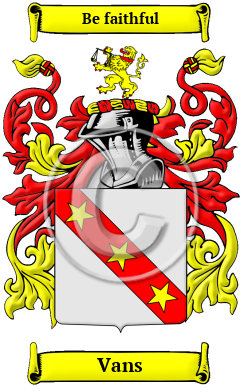
| ![Show Contents]() Vans History, Family Crest & Coats of Arms Vans History, Family Crest & Coats of Arms
Etymology of VansWhat does the name Vans mean? The name Vans was carried to England in the enormous movement of people that followed the Norman Conquest of 1066. The Vans family lived in East Lothian, Scotland. Their name, however, is a reference to Vaux or Vallibus, Normandy, the family's place of residence prior to the Norman Conquest of England in 1066. Early Origins of the Vans familyThe surname Vans was first found in East Lothian, where they were directly descended from the great baronial family of De Vaux, or De Vallibus, and still had a castle of this name in Normandy until the year 1080. They possessed Dalston and Gilliesland in Cumberland, and the barony of Dirletoun in East Lothian. Early History of the Vans familyThis web page shows only a small excerpt of our Vans research. Another 170 words (12 lines of text) covering the years 1244, 1255, 1306, 1437, 1490, 1515, 1516, 1538 and 1890 are included under the topic Early Vans History in all our PDF Extended History products and printed products wherever possible. Vans Spelling VariationsSpelling variations of this family name include: Vance, Vans, Vaux, de Vallibus and others. Early Notables of the Vans familyJohn Vaus or Vascus (1490?-1538?), Scottish Latinist, the earliest Scottish writer on grammar, born in Aberdeen. "He appears to have studied at Paris, and to have returned to his native town in 1515 or 1516, when he...
Another 37 words (3 lines of text) are included under the topic Early Vans Notables in all our PDF Extended History products and printed products wherever possible. Migration of the Vans family to IrelandSome of the Vans family moved to Ireland, but this topic is not covered in this excerpt.
Another 57 words (4 lines of text) about their life in Ireland is included in all our PDF Extended History products and printed products wherever possible.
| Vans migration to the United States | + |
Vans Settlers in United States in the 17th Century- Richard Vans, who arrived in Virginia in 1637 1
Vans Settlers in United States in the 18th Century- Andrew Vans, who arrived in Virginia in 1700 1
| Vans migration to Canada | + |
Vans Settlers in Canada in the 18th Century- Hugh Vans, who landed in Halifax, Nova Scotia in 1749-1752
- Samuel Vans, who landed in Nova Scotia in 1750
| Vans migration to New Zealand | + |
Emigration to New Zealand followed in the footsteps of the European explorers, such as Captain Cook (1769-70): first came sealers, whalers, missionaries, and traders. By 1838, the British New Zealand Company had begun buying land from the Maori tribes, and selling it to settlers, and, after the Treaty of Waitangi in 1840, many British families set out on the arduous six month journey from Britain to Aotearoa to start a new life. Early immigrants include: Vans Settlers in New Zealand in the 19th Century- Mr. James Vans (Van), (b. 1816), aged 25, British labourer travelling from Gravesend aboard the ship "Lord William Bentinck" arriving in Wellington, New Zealand on 24th May 1841 2
The motto was originally a war cry or slogan. Mottoes first began to be shown with arms in the 14th and 15th centuries, but were not in general use until the 17th century. Thus the oldest coats of arms generally do not include a motto. Mottoes seldom form part of the grant of arms: Under most heraldic authorities, a motto is an optional component of the coat of arms, and can be added to or changed at will; many families have chosen not to display a motto.
Motto: Be faithful
- Filby, P. William, Meyer, Mary K., Passenger and immigration lists index : a guide to published arrival records of about 500,000 passengers who came to the United States and Canada in the seventeenth, eighteenth, and nineteenth centuries. 1982-1985 Cumulated Supplements in Four Volumes Detroit, Mich. : Gale Research Co., 1985, Print (ISBN 0-8103-1795-8)
- New Zealand Yesteryears Passenger Lists 1800 to 1900 (Retrieved 17th October 2018). Retrieved from http://www.yesteryears.co.nz/shipping/passlist.html
 |