| ![Show Contents]() Vickery History, Family Crest & Coats of Arms Vickery History, Family Crest & Coats of Arms
Etymology of VickeryWhat does the name Vickery mean? The Norman Conquest of England in 1066 added many new elements to an already vibrant culture. Among these were thousands of new names. The Vickery family lived in Devon. Their name, however, is a reference to La Vacherie, Normandy, the family's place of residence prior to the Norman Conquest of England in 1066. Early Origins of the Vickery familyThe surname Vickery was first found in Devon. They were originally from La Vacherie, and acquired their seat at Dunkeswell in Devon soon after the Norman Conquest in 1066. Early History of the Vickery familyThis web page shows only a small excerpt of our Vickery research. Another 42 words (3 lines of text) covering the years 1490 and 1561 are included under the topic Early Vickery History in all our PDF Extended History products and printed products wherever possible. Vickery Spelling VariationsEndless spelling variations are a prevailing characteristic of Norman surnames. Old and Middle English lacked any definite spelling rules, and the introduction of Norman French added an unfamiliar ingredient to the English linguistic stew. French and Latin, the languages of the court, also influenced spellings. Finally, Medieval scribes generally spelled words according to how they sounded, so one person was often referred to by different spellings in different documents. The name has been spelled Vickare, Vickery, Vickary and others. Early Notables of the Vickery familyThomas Vicary (1490-1561), an early English physician, surgeon and anatomist, born in Kent, he was, "but a meane practiser in Maidstone." Henry VIII advanced him to the position of sergeant-surgeon to the Royal Household; and he became a...
Another 37 words (3 lines of text) are included under the topic Early Vickery Notables in all our PDF Extended History products and printed products wherever possible. Vickery RankingIn the United States, the name Vickery is the 3,194th most popular surname with an estimated 9,948 people with that name. 1 Migration of the Vickery family to IrelandSome of the Vickery family moved to Ireland, but this topic is not covered in this excerpt. More information about their life in Ireland is included in all our PDF Extended History products and printed products wherever possible.
| Vickery migration to Australia | + |
Emigration to Australia included the Third Fleet of convicts, tradespeople and early settlers. Early immigrants include: Third Fleet - Mr. William Vickery, (b. 1762), aged 25, English settler convicted in Exeter, Devon on 20th March 1786, sentenced for 7 years for theft, transported aboard the ship "Charlotte" leaving on 13th May 1787 arriving in New South Wales, Australia on 22nd January 1788 2
Following the Third Fleets, other convicts and early settlers arriving in Australia include: Vickery Settlers in Australia in the 19th Century- Mr. Francis Vickery who was convicted in Liverpool, Merseyside, England for 7 years, transported aboard the "Dick" on 2nd October 1820, arriving in New South Wales, Australia 3
- Mr. John Vickery, English convict who was convicted in Surrey, England for 7 years, transported aboard the "Chapman" on 6th April 1824, arriving in Tasmania (Van Diemen's Land) 4
- Joseph Vickery, a shoemaker, who arrived in New South Wales, Australia sometime between 1825 and 1832
- Mr. John Vickery, English convict who was convicted in Middlesex, England for 7 years, transported aboard the "Florentia" on 14th August 1827, arriving in New South Wales, Australia 5
- Mr. James Vickery, English convict who was convicted in West Riding, Yorkshire, England for 7 years, transported aboard the "Exmouth" on 3rd March 1831, arriving in New South Wales, Australia 6
- ... (More are available in all our PDF Extended History products and printed products wherever possible.)
| Vickery migration to New Zealand | + |
Emigration to New Zealand followed in the footsteps of the European explorers, such as Captain Cook (1769-70): first came sealers, whalers, missionaries, and traders. By 1838, the British New Zealand Company had begun buying land from the Maori tribes, and selling it to settlers, and, after the Treaty of Waitangi in 1840, many British families set out on the arduous six month journey from Britain to Aotearoa to start a new life. Early immigrants include: Vickery Settlers in New Zealand in the 19th Century- Mr. Amos Vickery, British settler travelling from London aboard the ship "Rock City" arriving in Auckland, New Zealand on 4th June 1855 7
- Mr. Vickery, British settler travelling from Plymouth aboard the ship "Joseph Fletcher" arriving in Auckland, New Zealand on 19th March 1858 8
- Mrs. Vickery, British settler travelling from Plymouth aboard the ship "Joseph Fletcher" arriving in Auckland, New Zealand on 19th March 1858 8
| Vickery migration to West Indies | + |
The British first settled the British West Indies around 1604. They made many attempts but failed in some to establish settlements on the Islands including Saint Lucia and Grenada. By 1627 they had managed to establish settlements on St. Kitts (St. Christopher) and Barbados, but by 1641 the Spanish had moved in and destroyed some of these including those at Providence Island. The British continued to expand the settlements including setting the First Federation in the British West Indies by 1674; some of the islands include Barbados, Bermuda, Cayman Island, Turks and Caicos, Jamaica and Belize then known as British Honduras. By the 1960's many of the islands became independent after the West Indies Federation which existed from 1958 to 1962 failed due to internal political conflicts. After this a number of Eastern Caribbean islands formed a free association. 9Vickery Settlers in West Indies in the 17th Century- John Vickery, who settled in Barbados in 1654
| Vickery migration to Canada | + |
Vickery Settlers in Canada in the 20th Century- William Vickery, who arrived in Saint John, New Brunswick in 1907
| Vickery migration to the United States | + |
Vickery Settlers in United States in the 17th Century- Seth Vickery, who landed in New England in 1680 10
Vickery Settlers in United States in the 18th Century- Mary Vickery, who settled in Maryland in 1724
- Ambrose Vickery, who settled in Georgia in 1733
Vickery Settlers in United States in the 19th Century- James Vickery, who landed in San Francisco, California in 1850 10
- Henry Vickery, who settled in Philadelphia in 1856
- John Vickery, who arrived in New York, NY in 1884 10
- George W Vickery, who arrived in Iroquois County, Illinois in 1886 10
- Frank Vickery, who landed in Iroquois County, Illinois in 1888 10
| Contemporary Notables of the name Vickery (post 1700) | + |
- Samuel Vickery VC (1873-1952), English recipient of the Victoria Cross
- Ebenezer Vickery (1827-1906), English-born, Australian businessman, pastoralist and philanthropist
- Philip "Phil" Vickery (b. 1961), English celebrity chef
- Tim Vickery (b. 1965), English football journalist
- Joe Vickery (b. 1989), English rugby league player
- Philip John "Phil" Vickery MBE (b. 1976), former English rugby union tighthead prop and member of the England squad
- Peter Vickery (1949-1950), Australian jurist, Trials Division justice at the Supreme Court of Victoria and sat as a judge of the Commercial Court
- Frank Vickery (1951-2018), Welsh playwright and actor
- Brian Campbell Vickery (1918-2009), Australian-born, British information scientist and classification researcher
- ... (Another 24 notables are available in all our PDF Extended History products and printed products wherever possible.)
| Historic Events for the Vickery family | + |
- Mrs. Martha Vickery (d. 1979), American passenger from Momence, Illinois, USA, who flew aboard American Airlines Flight 191 and died in the crash 11
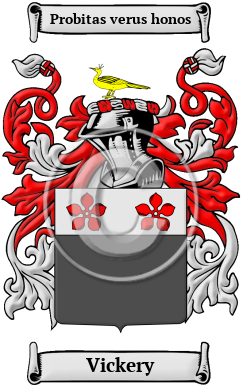
The motto was originally a war cry or slogan. Mottoes first began to be shown with arms in the 14th and 15th centuries, but were not in general use until the 17th century. Thus the oldest coats of arms generally do not include a motto. Mottoes seldom form part of the grant of arms: Under most heraldic authorities, a motto is an optional component of the coat of arms, and can be added to or changed at will; many families have chosen not to display a motto.
Motto: Probitas verus honos
Motto Translation: Probity is true honor.
- "What are the 5,000 Most Common Last Names in the U.S.?". NameCensus.com, https://namecensus.com/last-names/
- Convict Records of Australia. Retrieved 4th February 2021 from https://convictrecords.com.au/ships
- Convict Records Voyages to Australia (Retrieved 8th July 2021). Retrieved from https://convictrecords.com.au/ships/Dick
- Convict Records of Australia. Retreived 26th January 2021 from https://convictrecords.com.au/ships/chapman
- Convict Records Voyages to Australia (Retrieved 5th October 2022). https://convictrecords.com.au/ships/florentia
- Convict Records Voyages to Australia (Retrieved 25th May 2022). https://convictrecords.com.au/ships/exmouth
- New Zealand Yesteryears Passenger Lists 1800 to 1900 (Retrieved 26th March 2019). Retrieved from http://www.yesteryears.co.nz/shipping/passlist.html
- New Zealand Yesteryears Passenger Lists 1800 to 1900 (Retrieved 17th October 2018). Retrieved from http://www.yesteryears.co.nz/shipping/passlist.html
- https://en.wikipedia.org/wiki/British_West_Indies
- Filby, P. William, Meyer, Mary K., Passenger and immigration lists index : a guide to published arrival records of about 500,000 passengers who came to the United States and Canada in the seventeenth, eighteenth, and nineteenth centuries. 1982-1985 Cumulated Supplements in Four Volumes Detroit, Mich. : Gale Research Co., 1985, Print (ISBN 0-8103-1795-8)
- Flight 191's Victims - latimes. (Retrieved 2014, April 16) . Retrieved from http://articles.latimes.com/1985-08-04/news/mn-4349_1_fort-lauderdale-area
 |