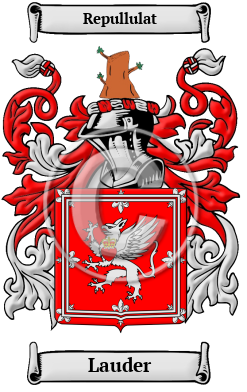
| ![Show Contents]() Lauder History, Family Crest & Coats of Arms Lauder History, Family Crest & Coats of Arms
Etymology of LauderWhat does the name Lauder mean? A Boernician family in ancient Scotland were the ancestors of those who first used the name Lauder. They lived in Berwickshire, Scotland where they took their name from the lands of Lauder, first granted to them by King Malcolm Ceanmore about 1057 AD. "This place, of which the name, in the Celtic language, is descriptive of its situation in the valley of the Leader [River], was granted in the early part of the 12th century, by David I." 1 Another source claims the name was from Lauder (Lowther) meaning famous warrior. 2 Early Origins of the Lauder familyThe surname Lauder was first found in Berwickshire an ancient county of Scotland, presently part of the Scottish Borders Council Area, located in the eastern part of the Borders Region of Scotland, where Robert Lauder was the first Chief of the Clan. His successor Sir Robert de Lauedre, witnessed a charter by John de Mautelent to the Abbey of Dryburgh at an undetermined date some time in the early to mid 13th century. "Bass Isle in the parish of North Berwick, county of Haddington was an ancient possession of the family of Lawder, and was purchased, in 1671, by Charles II." 1 Early record show: "Robert de Lavedre is said to have obtained lands in Berwickshire from Malcolm Canmore. Sir Robert de Lauedre witnessed a charter by John de Mautelent to the Abbey of Dryburgh (Dryburgh), and William de Lawedre appears as sheriff of Perthshire in reign of Alexander III. As early as 1297 the Lauders were possessors of the Bass Rock in the Firth of Forth. Robert de Lauueder, who had a charter of the lands of Colden in barony of Dalkeith, 1316, may be Robert de Loweder, justiciar of Lothian, 1327-1331. Another Robert de Lawdre was one of the borowis for the earl of Douglas's bounds on the Middle March, 1398." 3 Early History of the Lauder familyThis web page shows only a small excerpt of our Lauder research. Another 174 words (12 lines of text) covering the years 1239, 1315, 1333, 1388, 1413, 1420, 1425, 1426, 1445, 1451, 1465, 1477, 1478, 1480, 1498, 1550, 1595, 1646, 1669, 1692, 1698, 1699, 1701, 1702, 1714, 1722, 1728, 1730 and 1771 are included under the topic Early Lauder History in all our PDF Extended History products and printed products wherever possible. Lauder Spelling VariationsSpelling variations occur frequently in Scottish names that date from the medieval era. They result from a general lack of grammatical rules and the tendency to spell names according to sound. Lauder has been spelled Lauder, Laudor, Lawder, Lawther, Leather, Lauther and others. Early Notables of the Lauder family- Sir John Lauder, 1st Baronet, of Newington and Fountainhall (1595-1692), Scottish baillie and Treasurer of the City of Edinburgh
- Sir John Lauder of Fountainhall, 2nd Baronet, Lord Fountainhall (1646-1722), one of Scotland's leading jurists
- Sir John Lauder of Fountainhall, 3rd Baronet (1669-1728), Scottish burgess of Aberdeen (1701), city of Edinburgh (1702), North Berwick (1702) and Elgin (1714)
- Sir Alexander Lauder of Fountainhall, 4th Baronet (1698-1730) Honorary Burgess of the City of Glasgow
- all of the above were interred in the Lauder burial vault within Greyfriars Kirk
Migration of the Lauder family to IrelandSome of the Lauder family moved to Ireland, but this topic is not covered in this excerpt. More information about their life in Ireland is included in all our PDF Extended History products and printed products wherever possible.
| Lauder migration to Australia | + |
Lauder Settlers in Australia in the 19th Century- John Lauder, aged 32, who arrived in South Australia in 1849 aboard the ship "Emily" 4
- John Lauder, who arrived in Adelaide, Australia aboard the ship "Emily" in 1849 4
- William Lauder, aged 22, a carpenter, who arrived in South Australia in 1854 aboard the ship "Dirigo" 5
| Lauder migration to New Zealand | + |
Emigration to New Zealand followed in the footsteps of the European explorers, such as Captain Cook (1769-70): first came sealers, whalers, missionaries, and traders. By 1838, the British New Zealand Company had begun buying land from the Maori tribes, and selling it to settlers, and, after the Treaty of Waitangi in 1840, many British families set out on the arduous six month journey from Britain to Aotearoa to start a new life. Early immigrants include: Lauder Settlers in New Zealand in the 19th Century- Mr. James Lauder, Scottish settler travelling from Glasgow aboard the ship "Storm Cloud" arriving in Dunedin, Otago, South Island, New Zealand on 27th April 1860 6
- Miss Emily Lauder, (b. 1833), aged 28, British domestic servant travelling from London aboard the ship "Mystery" arriving in Lyttelton, Christchurch, South Island, New Zealand on 7th January 1862 7
- Edward Lauder, aged 24, a farm labourer, who arrived in Wellington, New Zealand aboard the ship "Wairoa" in 1877
- Mr. Edward Lauder, (b. 1853), aged 24, Cornish farm Labourer departing on 7th July 1877 aboard the ship "Wairoa" arriving in Wellington, New Zealand on 19th October 1877 8
| Lauder migration to Canada | + |
Lauder Settlers in Canada in the 19th Century- Nathaniel Lauder, who landed in Esquimalt, British Columbia in 1862
| Lauder migration to the United States | + |
Lauder Settlers in United States in the 17th Century- D Lauder, who landed in Texas in 1650-1906 9
Lauder Settlers in United States in the 18th Century- Peter Lauder, who arrived in Virginia in 1704 9
- George Lauder, who settled in Virginia in 1716
- Mary Lauder, who arrived in Georgia in 1795 9
Lauder Settlers in United States in the 19th Century- John and Sarah Lauder, who settled in Belfast Maine in 1820
- George Lauder, who arrived in North Carolina in 1851 9
| Contemporary Notables of the name Lauder (post 1700) | + |
- Estée Lauder (1908-2004), American entrepreneur, co-founder and namesake of Estée Lauder, Inc., with her husband, Joseph, in 1946, recipient of the Presidential Medal of Freedom
- Sir Andrew Lauder of Fountainhall (1702-1769), 5th Baronet, Scottish Burgess of the Royal Burgh of Lauder (1737), and Musselburgh (1739)
- Sir Thomas Dick Lauder (1784-1848), Scottish writer, he served in the Cameron Highlanders as a young man before settling down and marrying the heiress of the Regulas baronetcy in 1808, best known for his two romances, as well as two compilations of Scottish legends and "An Account of the Great Morayshire Floods," published in 1830
- William Lauder (1680-1771), Scottish scholar
- Robert Scott Lauder (1803-1869), Scottish painter
- Sir Harry Lauder (1870-1950), Scottish famous ballad singer and music hall comedian
- Andrew Justus Lauder (1947-2025), British record company executive and A&R manager
- Leonard Alan Lauder (1933-2025), American billionaire, philanthropist, and art collector, CEO of the Estée Lauder Companies Inc
- Billy Lauder (1874-1933), American Major League Baseball player
- ... (Another 3 notables are available in all our PDF Extended History products and printed products wherever possible.)
The motto was originally a war cry or slogan. Mottoes first began to be shown with arms in the 14th and 15th centuries, but were not in general use until the 17th century. Thus the oldest coats of arms generally do not include a motto. Mottoes seldom form part of the grant of arms: Under most heraldic authorities, a motto is an optional component of the coat of arms, and can be added to or changed at will; many families have chosen not to display a motto.
Motto: Repullulat
Motto Translation: It buds afresh.
| Suggested Readings for the name Lauder | + |
- The Lauder Family in America by Margaret Emily Lauder.
- Lewis, Samuel, A Topographical Dictionary of Scotland. Institute of Historical Research, 1848, Print.
- Smith, Eldson Coles, New Dictionary of American Family Names New York: Harper & Row, 1956. Print
- Black, George F., The Surnames of Scotland Their Origin, Meaning and History. New York: New York Public Library, 1946. Print. (ISBN 0-87104-172-3)
- State Records of South Australia. (Retrieved 2010, November 5) The EMILY 1849. Retrieved from http://www.slsa.sa.gov.au/BSA/1849Emily.htm
- South Australian Register Thursday 23rd November 1854. (Retrieved 2010, November 5) Dirigo 1854. Retrieved http://www.theshipslist.com/ships/australia/dirigo1854.shtml
- New Zealand Yesteryears Passenger Lists 1800 to 1900 (Retrieved 26th March 2019). Retrieved from http://www.yesteryears.co.nz/shipping/passlist.html
- New Zealand Yesteryears Passenger Lists 1800 to 1900 (Retrieved 17th October 2018). Retrieved from http://www.yesteryears.co.nz/shipping/passlist.html
- Cornwall Online Parish Clerks. (Retrieved 2018, April 30). Emigrants to Wellington 1872-1880 [PDF]. Retrieved from http://www.opc-cornwall.org/Resc/pdfs/emigration_nz_wellington.pdf
- Filby, P. William, Meyer, Mary K., Passenger and immigration lists index : a guide to published arrival records of about 500,000 passengers who came to the United States and Canada in the seventeenth, eighteenth, and nineteenth centuries. 1982-1985 Cumulated Supplements in Four Volumes Detroit, Mich. : Gale Research Co., 1985, Print (ISBN 0-8103-1795-8)
 |