| ![Show Contents]() Tunley History, Family Crest & Coats of Arms Tunley History, Family Crest & Coats of Arms
Etymology of TunleyWhat does the name Tunley mean? The Tunley name has descended through the generations from the ancient Anglo-Saxon culture. Their name comes from having lived in the settlement of Towneley in the county of Lancashire, or by any clearing in which a farm was situated. Tunley in Gloucestershire or Somerset, may be an alternate origin of the name. 1 The surname Tunley thus belongs to both the category of habitation names, which are derived from pre-existing names for towns, villages, parishes, or farmsteads, and class of topographic surnames, which were given to people who resided near physical features such as hills, streams, churches, or types of trees. Tunley Camp is an Iron Age hill fort located about 0.8 miles (1.3 km) north-east from the small village of Camerton in Somerset. Early Origins of the Tunley familyThe surname Tunley was first found in Lancashire where they were descended from Spartlingus, the first Dean of Whalley about 896 A.D. Descended was Liwlphus, Cudwlphus, Henricus the great Baron of Whalley. He was followed by Robertus, Geoffrey who married the daughter of Roger de Lacy, Constable of Cheshire in 1193. "An estate in Lancashire, which belonged to this ancient and distinguished family, whose pedigree is said to be traced to the time of King Alfred, and to Spartlingus, first Dean of Whalley, who flourished about the year 896. The line of this personage terminated with an heiress, Cecilia of Towneley, in the XIV. century, who married John del Legh, and conveyed the estate to his family. He died in or about 1330, and his great-grandson resumed the ancient surname of Towneley. John del Legh was a cadet of the great Cheshire family of that name. Towneley Hall is still the seat of this race, who may well challenge comparison in point of venerable antiquity with any family in England." 2 Early History of the Tunley familyThis web page shows only a small excerpt of our Tunley research. Another 120 words (9 lines of text) covering the years 1375, 1376, 1377, 1531, 1600, 1604, 1629, 1644, 1674, 1683, 1686, 1692, 1697, 1707, 1711, 1737, 1760 and 1782 are included under the topic Early Tunley History in all our PDF Extended History products and printed products wherever possible. Tunley Spelling VariationsOnly recently has spelling become standardized in the English language. As the English language evolved in the Middle Ages, the spelling of names changed also. The name Tunley has undergone many spelling variations, including Townley, Towneley, Tunley and others. Early Notables of the Tunley familyCharles Towneley (1600-1644); and his son, Richard Towneley (1629-1707), an English mathematician and astronomer from Towneley near Burnley, Lancashire who first postulated a theory that Robert Boyle later publish as Boyle's Law, but Boyle referred to as Mr Towneley's hypothesis. Christopher Towneley (1604-1674), was an English antiquary, called 'the Transscriber,' and was the son of Richard Towneley...
Another 55 words (4 lines of text) are included under the topic Early Tunley Notables in all our PDF Extended History products and printed products wherever possible. Migration of the Tunley family to IrelandSome of the Tunley family moved to Ireland, but this topic is not covered in this excerpt.
Another 34 words (2 lines of text) about their life in Ireland is included in all our PDF Extended History products and printed products wherever possible.
| Tunley migration to the United States | + |
To escape the unstable social climate in England of this time, many families boarded ships for the New World with the hope of finding land, opportunity, and greater religious and political freedom. Although the voyages were expensive, crowded, and difficult, those families that arrived often found greater opportunities and freedoms than they could have experienced at home. Many of those families went on to make significant contributions to the rapidly developing colonies in which they settled. Early North American records indicate many people bearing the name Tunley were among those contributors:
Tunley Settlers in United States in the 18th Century- William Tunley, who arrived in Virginia in 1714 3
| Tunley migration to Canada | + |
Tunley Settlers in Canada in the 18th Century- Thomas Tunley, who landed in Nova Scotia in 1749
| Tunley migration to Australia | + |
Tunley Settlers in Australia in the 19th Century- William Tunley, aged 24, who arrived in South Australia in 1849 aboard the ship "Florentia" 4
| Contemporary Notables of the name Tunley (post 1700) | + |
- Wayland Tunley (1937-2012), British architect, known for his designs for several developments in Milton Keynes for Milton Keynes Development Corporation
- Richard Frank Tunley (1879-1968), Australian blinds manufacturer and inventor of educational resources, born in Wolverhampton, Staffordshire; he and his family of 9 siblings, mother and father emigrated to Australia in 1884 and settled in South Brisbane
- David Evatt Tunley AM FAHA (1930-2024), Australian musicologist and composer, noted for his work on François Couperin and French music in the 17th and 18th centuries, Emeritus Professor at the School of Music, University of Western Australia
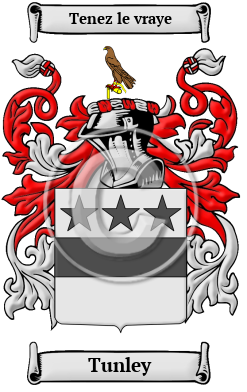
The motto was originally a war cry or slogan. Mottoes first began to be shown with arms in the 14th and 15th centuries, but were not in general use until the 17th century. Thus the oldest coats of arms generally do not include a motto. Mottoes seldom form part of the grant of arms: Under most heraldic authorities, a motto is an optional component of the coat of arms, and can be added to or changed at will; many families have chosen not to display a motto.
Motto: Tenez le vraye
Motto Translation: Keep or speak the truth.
- Harrison, Henry, Surnames of the United Kingdom: A Concise Etymological Dictionary Baltimore: Geneological Publishing Company, 2013. Print
- Lower, Mark Anthony, Patronymica Britannica, A Dictionary of Family Names of the United Kingdom. London: John Russel Smith, 1860. Print.
- Filby, P. William, Meyer, Mary K., Passenger and immigration lists index : a guide to published arrival records of about 500,000 passengers who came to the United States and Canada in the seventeenth, eighteenth, and nineteenth centuries. 1982-1985 Cumulated Supplements in Four Volumes Detroit, Mich. : Gale Research Co., 1985, Print (ISBN 0-8103-1795-8)
- State Records of South Australia. (Retrieved 2010, November 5) FLORENTIA 1849. Retrieved from http://www.slsa.sa.gov.au/BSA/1849Florentia.htm
 |