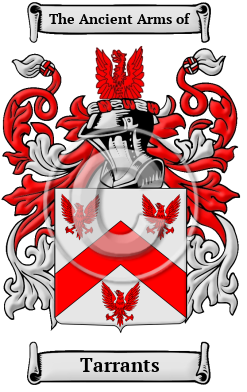
| ![Show Contents]() Tarrants History, Family Crest & Coats of Arms Tarrants History, Family Crest & Coats of Arms
Etymology of TarrantsWhat does the name Tarrants mean? The name Tarrants first arose amongst the Anglo-Saxon tribes of Britain. It is derived from their having lived in Dorset at one of the eight places that have the prefix Tarrant. They include: Tarrant Crawford; Tarrant Gunville; Tarrant Hinton; Tarrant Keyneston; Tarrant Launceston; Tarrant Monkton; Tarrant Rawston; and Tarrant Rushton. The place name Tarrant is derived from the "Celtic river-name possibly meaning 'the trespasser' and in 'river liable to floods." 1 All of these parishes and villages are in the Blandford union, hundred of Pimperne 2 and are collectively listed in the Domesday Book as Tarente. 3 It seems that in the 13th century the parishes either expanded or separated and accordingly a suffix was needed to distinguish them. In many cases, the suffix was used to denote the families that lived there as in: Tarrant Gunville, home to the Gundeville family; Tarrant Keyneston, home of the Cahaignes family; Tarant Launceston, home to the Lowin family; Tarrant Rawston, home to the Antioch family; and Tarrant Rushton, home to the de Rusceaus family. The one exception was Tarrant Monkton which denoted as 'estate belonging to the monks of Tewkesbury Abbey.' 1 Early Origins of the Tarrants familyThe surname Tarrants was first found in one of the aforementioned villages named Tarrant in Dorset. Some of the first records of the surname include Reginald de Tarenta who was listed in Lancashire in 1190, John de Tarent who was listed in the Curia Regis Rolls of Middlesex in 1212 and Ralph Tauraunt who was listed in the Subsidy Rolls of Sussex in 1296. 4 The Hundredorum Rolls of 1273 list Abbatissa de Tarento in Dorset in 1273. 5 Early History of the Tarrants familyThis web page shows only a small excerpt of our Tarrants research. Another 95 words (7 lines of text) covering the years 1086, 1621, 1642, 1646 and 1784 are included under the topic Early Tarrants History in all our PDF Extended History products and printed products wherever possible. Tarrants Spelling VariationsOne relatively recent invention that did much to standardize English spelling was the printing press. However, before its invention even the most literate people recorded their names according to sound rather than spelling. The spelling variations under which the name Tarrants has appeared include Tarrant, Tarrents, Tarrent, Tarant, Tarent, Tarrat, Tarrett and many more. Early Notables of the Tarrants familyMore information is included under the topic Early Tarrants Notables in all our PDF Extended History products and printed products wherever possible. Migration of the Tarrants family to IrelandSome of the Tarrants family moved to Ireland, but this topic is not covered in this excerpt.
Another 40 words (3 lines of text) about their life in Ireland is included in all our PDF Extended History products and printed products wherever possible. Migration of the Tarrants familyAt this time, the shores of the New World beckoned many English families that felt that the social climate in England was oppressive and lacked opportunity for change. Thousands left England at great expense in ships that were overcrowded and full of disease. A great portion of these settlers never survived the journey and even a greater number arrived sick, starving, and without a penny. The survivors, however, were often greeted with greater opportunity than they could have experienced back home. These English settlers made significant contributions to those colonies that would eventually become the United States and Canada. An examination of early immigration records and passenger ship lists revealed that people bearing the name Tarrants arrived in North America very early: Mr. and Mrs. Francis Tarrant, who sailed to Boston, Massachusetts in 1712; Henry Tarrant to Virginia in 1731; and John Tarrant to America in 1754.
| Contemporary Notables of the name Tarrants (post 1700) | + |
- William E Tarrants, American government official
- Mills, A.D., Dictionary of English Place-Names. Oxford: Oxford University Press, 1991. Print. (ISBN 0-19-869156-4)
- Lewis, Samuel, A Topographical Dictionary of England. Institute of Historical Research, 1848, Print.
- Williams, Dr Ann. And G.H. Martin, Eds., Domesday Book A Complete Translation. London: Penguin, 1992. Print. (ISBN 0-141-00523-8)
- Reaney, P.H and R.M. Wilson, A Dictionary of English Surnames. London: Routledge, 1991. Print. (ISBN 0-415-05737-X)
- Bardsley, C.W, A Dictionary of English and Welsh Surnames: With Special American Instances. Wiltshire: Heraldry Today, 1901. Print. (ISBN 0-900455-44-6)
 |