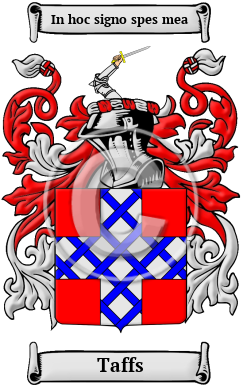
| ![Show Contents]() Taffs History, Family Crest & Coats of Arms Taffs History, Family Crest & Coats of Arms
- Origins Available:
Ireland
Etymology of TaffsWhat does the name Taffs mean? While this surname is generally regarded as Irish, we must look further back to properly understand its origin. Taffs is actually derived from the Welsh name Taaffe, which is a form of the personal name David and is related to the modern pet name Taffy. The Irish Gaelic form of the surname Taffs is Táth, which is pronounced, and indeed, often spelled, Taa. Early Origins of the Taffs familyThe surname Taffs was first found in County Louth (Irish: Lú) the smallest county in Ireland, located on the East coast, in the Province of Leinster where the family rapidly rose to positions of great importance shortly after their settlement during the Anglo-Norman invasion of Ireland. "Lord Taafe's ancestors were a Welsh family, who settled in Ireland at the English invasion." 1 Sir Nicholas Taafe's grandson, Richard Taafe seated at Castle Lumpnagh was Sheriff of Dublin in 1295, and later Sheriff of County Louth in 1315. His son was Archbishop of Armagh. This line of early nobility continued well into the 14th and 15th centuries with more Sheriffs of Louth on record. 2 Early History of the Taffs familyThis web page shows only a small excerpt of our Taffs research. Another 136 words (10 lines of text) covering the years 1284, 1441, 1603, 1639, 1641, 1642, 1649, 1661, 1677, 1685, 1688, 1695, 1696, 1704 and 1708 are included under the topic Early Taffs History in all our PDF Extended History products and printed products wherever possible. Taffs Spelling VariationsMedieval scribes and church officials spelt names simply the way they sounded, which explains the various name spelling variations of the name Taffs that were encountered when researching that surname. The many spelling variations included: Taafe, Taaf, Taffe, Taffee, Taffie, Taffey and others. Early Notables of the Taffs familyJohn Taaffe, 1st Viscount Taaffe (died before 1641); Theobald Taaffe, 1st Earl of Carlingford (c. 1603-1677), 2nd Viscount Taaffe, of Corren and 2nd Baron of Ballymote between 1642 and 1661, Irish Royalist officer who played a prominent part in the Wars of the Three Kingdoms, and accompanied Charles II in exile. Upon the Restoration, he was created 1st Earl of Carlingford; and Francis Taaffe, 3rd Earl of Carlingford (1639-1704), Irish army commander and politician. John Taaffe (fl. 1685-1708), was an Irish informer and Irish priest whose real name is said to have been Thomas O'Mullen. "He also at one time styled...
Another 128 words (9 lines of text) are included under the topic Early Taffs Notables in all our PDF Extended History products and printed products wherever possible. Migration of the Taffs familyA great number of Irish families left their homeland in the late 18th century and throughout the 19th century, migrating to such far away lands as Australia and North America. The early settlers left after much planning and deliberation. They were generally well off but they desired a tract of land that they could farm solely for themselves. The great mass of immigrants to arrive on North American shores in the 1840s differed greatly from their predecessors because many of them were utterly destitute, selling all they had to gain a passage on a ship or having their way paid by a philanthropic society. These Irish people were trying to escape the aftermath of the Great Potato Famine: poverty, starvation, disease, and, for many, ultimately death. Those that arrived on North American shores were not warmly welcomed by the established population, but they were vital to the rapid development of the industry, agriculture, and infrastructure of the infant nations of the United States and what would become Canada. Early passenger and immigration lists reveal many Irish settlers bearing the name Taffs: John Taafe settled in St. John's, Newfoundland in 1809; Joanne Taaffee settled in Virginia in 1654; Patrick Taaffe settled in Pennsylvania in 1773.
The motto was originally a war cry or slogan. Mottoes first began to be shown with arms in the 14th and 15th centuries, but were not in general use until the 17th century. Thus the oldest coats of arms generally do not include a motto. Mottoes seldom form part of the grant of arms: Under most heraldic authorities, a motto is an optional component of the coat of arms, and can be added to or changed at will; many families have chosen not to display a motto.
Motto: In hoc signo spes mea
Motto Translation: In this sign is my hope.
- Lower, Mark Anthony, Patronymica Britannica, A Dictionary of Family Names of the United Kingdom. London: John Russel Smith, 1860. Print.
- MacLysaght, Edward, Irish Families Their Names, Arms and Origins 4th Edition. Dublin: Irish Academic, 1982. Print. (ISBN 0-7165-2364-7)
 |