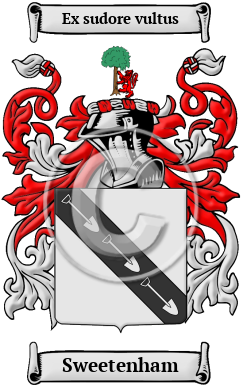
| ![Show Contents]() Sweetenham History, Family Crest & Coats of Arms Sweetenham History, Family Crest & Coats of Arms
- Origins Available:
England
Etymology of SweetenhamWhat does the name Sweetenham mean? The Anglo-Saxon name Sweetenham comes from the family having resided in the county of Cheshire, where they held a family seat at Swettenham. The surname Sweetenham is a habitation name that was originally derived from pre-existing names for towns, villages, parishes, or farmsteads. The surname originated as a means of identifying individuals from a particular area. In the Middle Ages people often assumed the name of the place that they originally lived as their surname during the course of travel. Early Origins of the Sweetenham familyThe surname Sweetenham was first found in Cheshire at Swettenham, a small village and civil parish. The place name was originally Suetenham in the late 12th century which literally meant "homestead or enclosure of a man called Sweta." 1 Swettenham Hall is a country house located there dating back to the 17th century. The first Saxon Lord of Swettenham, Peter, had his estates confirmed by King William Rufus. Early History of the Sweetenham familyThis web page shows only a small excerpt of our Sweetenham research. Another 63 words (4 lines of text) covering the years 1500, 1577, 1602, 1606, 1617, 1618 and 1622 are included under the topic Early Sweetenham History in all our PDF Extended History products and printed products wherever possible. Sweetenham Spelling VariationsSweetenham has been spelled many different ways. Before English spelling became standardized over the last few hundred years, spelling variations in names were a common occurrence. As the English language changed in the Middle Ages, absorbing pieces of Latin and French, as well as other languages, the spelling of people's names also changed considerably, even over a single lifetime. Spelling variants included: Swettenham, Swetenham, Sweetham, Swetnam and others. Early Notables of the Sweetenham familyJoseph Swetnam (fl. 1617), called the woman-hater, " he kept a fencing school at Bristol. He must be distinguished from his contemporary namesake, Joseph Swetnam, Sweetnam, or Sweetman (1577-1622), a native of...
Another 32 words (2 lines of text) are included under the topic Early Sweetenham Notables in all our PDF Extended History products and printed products wherever possible. Migration of the Sweetenham familyIn an attempt to escape the chaos experienced in England, many English families boarded overcrowded and diseased ships sailing for the shores of North America and other British colonies. Those families hardy enough, and lucky enough, to make the passage intact were rewarded with land and a social environment less prone to religious and political persecution. Many of these families became important contributors to the young colonies in which they settled. Early immigration and passenger lists have documented some of the first Sweetenhams to arrive on North American shores: Francis Swettnam who settled in Barbados in 1685; Alfred Swettenham, aged 22, who arrived at Ellis Island, in 1923; Constance S. Swettenham, aged 44, who arrived at Ellis Island from London, in 1903.
| Contemporary Notables of the name Sweetenham (post 1700) | + |
- Sir Frank A Sweetenham GCMG, CH (1850-1946), British colonial administrator who became the first Resident general of the Federated Malay States, King of Arms of the Order of St Michael and St George (1925-1938)
- Bill Sweetenham, Australian swim team manager for 4 Olympic Games and 5 Commonwealth Games
The motto was originally a war cry or slogan. Mottoes first began to be shown with arms in the 14th and 15th centuries, but were not in general use until the 17th century. Thus the oldest coats of arms generally do not include a motto. Mottoes seldom form part of the grant of arms: Under most heraldic authorities, a motto is an optional component of the coat of arms, and can be added to or changed at will; many families have chosen not to display a motto.
Motto: Ex sudore vultus
Motto Translation: By the sweat of the face.
- Mills, A.D., Dictionary of English Place-Names. Oxford: Oxford University Press, 1991. Print. (ISBN 0-19-869156-4)
 |