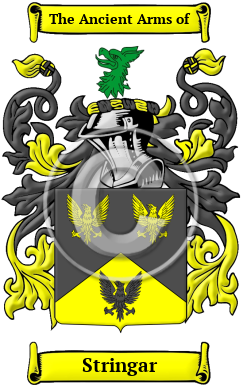
| ![Show Contents]() Stringar History, Family Crest & Coats of Arms Stringar History, Family Crest & Coats of Arms
Etymology of StringarWhat does the name Stringar mean? The ancient Norman culture that was established in England after the Conquest of 1066 produced the name of Stringar. It was given to a strong or courageous person. Checking further we found the name was derived from the German word streng, of the same meaning. It evolved to be an occupational name for "one who made strings for bows." 1 2 "In war if a string break, the man is lost and is no man, and his weapon is gone, and although he have two strings put on at once, yet he shah have small leisure and less room to bend his bow, therefore, God send us good stringers both for war and peace." 3 Early Origins of the Stringar familyThe surname Stringar was first found in Nottinghamshire where they held a family seat from early times, where they were Lords of the manor of Eaton, and were conjecturally descended from Fulk, who held the lands of Eaton from Roger de Bully at the time of the taking of the Domesday Book in 1086. 4 The lands, at that time, consisted of two mills and a garden. Eaton is the celebrated site of the Battle of the Idle in 617 between Redwald and Ethelfrith of Northumbria. The name grew to become a "common Yorkshire name" 5 which we will explore shortly. First we will search through early rolls: Walter Stringere was listed in the Curia Regis Rolls for Wiltshire in 1194; and Roger le Strenger in Yorkshire rolls in 1293. 5 Early Somerset records show Godwynn Strenger, Somerset, 1 Edward III (during the first year of King Edward III's reign.) 6 The Yorkshire Poll Tax Rolls of 1379 include: Willelmus Strynger; Johannes Strenger; and Ricardus Stryngar as all holding lands there at that time. 7 In Scotland, it was a rather rare name but we did find "Laurence Stringhar [who was] admitted burgess of Aberdeen, 1486." 8 Early History of the Stringar familyThis web page shows only a small excerpt of our Stringar research. Another 94 words (7 lines of text) covering the years 1574, 1575 and 1646 are included under the topic Early Stringar History in all our PDF Extended History products and printed products wherever possible. Stringar Spelling VariationsMultitudes of spelling variations are a hallmark of Anglo Norman names. Most of these names evolved in the 11th and 12th century, in the time after the Normans introduced their own Norman French language into a country where Old and Middle English had no spelling rules and the languages of the court were French and Latin. To make matters worse, medieval scribes spelled words according to sound, so names frequently appeared differently in the various documents in which they were recorded. The name was spelled Stringer, Stringar, Stringers and others. Early Notables of the Stringar familyMore information is included under the topic Early Stringar Notables in all our PDF Extended History products and printed products wherever possible. Migration of the Stringar familyBecause of this political and religious unrest within English society, many people decided to immigrate to the colonies. Families left for Ireland, North America, and Australia in enormous numbers, traveling at high cost in extremely inhospitable conditions. The New World in particular was a desirable destination, but the long voyage caused many to arrive sick and starving. Those who made it, though, were welcomed by opportunities far greater than they had known at home in England. Many of these families went on to make important contributions to the emerging nations of Canada and the United States. Analysis of immigration records indicates that some of the first North American immigrants bore the name Stringar or a variant listed above: Mr. Stringer who settled in Somers Island in 1662; Samuel Stringer settled in Virginia in 1622; followed by James in 1647; John in 1651; and Lettice in 1653.
- Smith, Eldson Coles, New Dictionary of American Family Names New York: Harper & Row, 1956. Print
- Lower, Mark Anthony, Patronymica Britannica, A Dictionary of Family Names of the United Kingdom. London: John Russel Smith, 1860. Print.
- Arthur, William , An Etymological Dictionary of Family and Christian Names. London: 1857. Print
- Williams, Dr Ann. And G.H. Martin, Eds., Domesday Book A Complete Translation. London: Penguin, 1992. Print. (ISBN 0-141-00523-8)
- Reaney, P.H and R.M. Wilson, A Dictionary of English Surnames. London: Routledge, 1991. Print. (ISBN 0-415-05737-X)
- Dickinson, F.H., Kirby's Quest for Somerset of 16th of Edward the 3rd London: Harrison and Sons, Printers in Ordinary to Her Majesty, St, Martin's Lane, 1889. Print.
- Bardsley, C.W, A Dictionary of English and Welsh Surnames: With Special American Instances. Wiltshire: Heraldry Today, 1901. Print. (ISBN 0-900455-44-6)
- Black, George F., The Surnames of Scotland Their Origin, Meaning and History. New York: New York Public Library, 1946. Print. (ISBN 0-87104-172-3)
 |