| ![Show Contents]() Southerlands History, Family Crest & Coats of Arms Southerlands History, Family Crest & Coats of Arms
- Origins Available:
Scotland
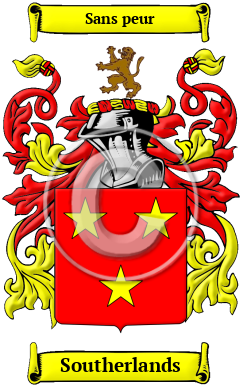
Etymology of SoutherlandsWhat does the name Southerlands mean? The ancestors of the Southerlands family were part of an ancient Scottish tribe called the Picts. They lived in the county of Sutherland in the north of Scotland. The name was derived from Old Norse suðr or "south" land, due to the area being south of Scandinavia and the Norse colonies in the Orkney and Shetland Islands. The Earls of Orkney referred to the Dales of Caithness as the Southland, even though they are in the more northern parts of Scotland. It was here that the great Lords of Freskin held their territory in the 11th century. They later intermarried with the great and royal house of Moray; hence, the three stars on the Sutherland coat of arms. Southerlands Coat of Arms CreationThe cat is the crest of the Sutherlands and the Mackintoshes. In the case of the Sutherlands, the cat has a paw uplifted as if to strike. Sir Robert Gordon of Aboyne, in his history of the Earldom of Sutherland, tells that when the Catti (a German tribe) were driven from their homes by the Romans in the first century, they were well received by the Scottish King, whom they assisted in all his valorous adventures. As a reward they got lands "in the remotest limits which lay void of inhabitants." In order to take possession they landed at the river Unes, now the Little Ferry, in Sutherland. Here the leader went ashore to spy the land, but was suddenly set upon by " monstrous large cats." The fight between man and cats was long and fierce, but in the end the man, who fought "without fear," managed to kill them all. Ever since, the cat has been the crest of the Sutherlands, with the French motto, " Sans peur " (Without fear). The other motto is "Francas non flectas " (You may break but shall not bend me). 1 Early Origins of the Southerlands familyThe surname Southerlands was first found in Caithness (Gaelic: Gallaibh), the northern tip of Scotland, a Norse/Viking controlled region from the 9th century, which became the Earldom of Caithness, where they held a family seat from the 11th century. Their early Clan chiefs were styled the Lords of Freskin in the Dales of Caithness. "The founder of the Clan of Sutherland settled in the XII. century in the province of Murref, Moray, or Moravia, comprehending the modern counties of Murray or Elgin, and parts of Inverness and Banff, whence the family for several generations assumed the name of Murref or De Moravia, which they retained even after their occupation of Sudrland or Sutherland, and their elevation to that earldom." 2 As the name was originally of territorial origin from the province of Moray, early records of the family referenced that territory. "William de Moravia (lord of Petty) was witness to a royal charter to the Abbey of Holyrood, 1203. A little earlier he appears as William, son of Freskin. Hucting de Moravia witnessed confirmation of sale of the land of Scrogges, c. 1208-13 and Malcolm de Moravia witnessed gift of a mark of silver annually to the Abbey of Arbroath, c. 1250." 3 Early History of the Southerlands familyThis web page shows only a small excerpt of our Southerlands research. Another 440 words (31 lines of text) covering the years 1211, 1333, 1389, 1598, 1601, 1639, 1674, 1676, 1682, 1705, 1710, 1719, 1734, 1745, 1759, 1768 and 1794 are included under the topic Early Southerlands History in all our PDF Extended History products and printed products wherever possible. Southerlands Spelling VariationsPrior to the invention of the printing press in the last hundred years, documents were basically unique. Names were written according to sound, and often appeared differently each time they were recorded. Spelling variations of the name Southerlands include Sutherland, Sutherlan, Suderland and many more. Early Notables of the Southerlands familyAlexander Sutherland, 1st Lord Duffus (d. 1674); James Sutherland, 2nd Lord Duffus (d. 1705); Kenneth Sutherland, 3rd Lord Duffus (d. 1734); James Sutherland (c. 1639-1719), the first...
Another 26 words (2 lines of text) are included under the topic Early Southerlands Notables in all our PDF Extended History products and printed products wherever possible. Migration of the Southerlands familyThe freedom of the North American colonies was enticing, and many Scots left to make the great crossing. It was a long and hard journey, but its reward was a place where there was more land than people and tolerance was far easier to come by. Many of these people came together to fight for a new nation in the American War of Independence, while others remained loyal to the old order as United Empire Loyalists. The ancestors of Scots in North America have recovered much of this heritage in the 20th century through Clan societies and other such organizations. A search of immigration and passenger lists revealed many important and early immigrants to North America bearing the name of Southerlands: James Sutherland known as the Yellow Haired James (Seumas Buidhe), led the mass migration sponsored by the Sutherland Transatlantic Friendly Association to the Selkirk settlement along the Red River Valley in mid western Canada. In 1814, 700 refugees from the Highland Clearances around Straconan sailed aboard the sailing ships Prince of Wales and the Eddystone..
The motto was originally a war cry or slogan. Mottoes first began to be shown with arms in the 14th and 15th centuries, but were not in general use until the 17th century. Thus the oldest coats of arms generally do not include a motto. Mottoes seldom form part of the grant of arms: Under most heraldic authorities, a motto is an optional component of the coat of arms, and can be added to or changed at will; many families have chosen not to display a motto.
Motto: Sans peur
Motto Translation: Without fear.
- Polson, Alexander, The Romance of Scottish Crests and Mottoes. Inverness: Walter Alexander, Inglis Street 1929. Print
- Lower, Mark Anthony, Patronymica Britannica, A Dictionary of Family Names of the United Kingdom. London: John Russel Smith, 1860. Print.
- Black, George F., The Surnames of Scotland Their Origin, Meaning and History. New York: New York Public Library, 1946. Print. (ISBN 0-87104-172-3)
 |