
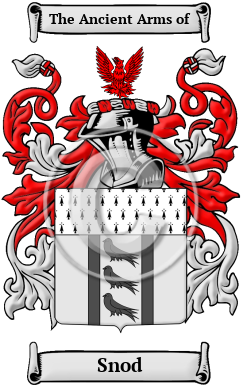
Show ContentsSnod History, Family Crest & Coats of Arms

Etymology of Snod

What does the name Snod mean?

The name Snod was first used by the ancient Strathclyde-Briton people of the Scottish/English Borderlands. The first Snod to use this name no doubt lived at the town of Snodgrass in the county of Ayrshire. The name of this place is derived from the Northern Old English words snod, meaning smooth, and grass, meaning grass.

Early Origins of the Snod family

The surname Snod was first found in Ayrshire (Gaelic: Siorrachd Inbhir Àir), formerly a county in the southwestern Strathclyde region of Scotland, that today makes up the Council Areas of South, East, and North Ayrshire, where they held a family seat from very ancient times, some say well before the Norman Conquest and the arrival of Duke William at Hastings in 1066 A.D.

Early History of the Snod family

This web page shows only a small excerpt of our Snod research. Another 95 words (7 lines of text) covering the years 1300, 1578, 1686 and 1890 are included under the topic Early Snod History in all our PDF Extended History products and printed products wherever possible.

Snod Spelling Variations

Scribes in Medieval Scotland spelled names by sound rather than any set of rules, so an enormous number of spelling variations exist in names of that era. Snod has been spelled Snodgrass, Snodgers, Snedgrass, Snadgrass and others.

Early Notables of the Snod family

  • Andrew Snodgrass of Bridgend

Migration of the Snod family to Ireland

Some of the Snod family moved to Ireland, but this topic is not covered in this excerpt.
Another 60 words (4 lines of text) about their life in Ireland is included in all our PDF Extended History products and printed products wherever possible.

Migration of the Snod family

The number of Strathclyde Clan families sailing for North America increased steadily as the persecution continued. In the colonies, they could find not only freedom from the iron hand of the English government, but land to settle on. The American War of Independence allowed many of these settlers to prove their independence, while some chose to go to Canada as United Empire Loyalists. Scots played essential roles in the forging of both great nations. Among them: Andrew and Mrs. Snodgrass arrived in Philadelphia in 1822; James, Robert, Samuel, and William Snodgrass all arrived in Philadelphia between 1840 and 1865..


Houseofnames.com on Facebook
