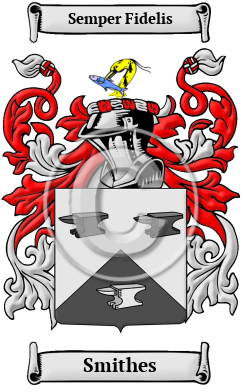
| ![Show Contents]() Smithes History, Family Crest & Coats of Arms Smithes History, Family Crest & Coats of Arms
Etymology of SmithesWhat does the name Smithes mean? The ancient Scottish name Smithes is rooted in the people of the Pictish clans. Smithes was a name for a smithy. Although Smithes appears to be an occupational name for a blacksmith, it has been suggested that when surnames came into use in Scotland, several different families simply 'took on' the name whether they had been blacksmiths or not. Thus, Smithes is a classic example of a polygenetic surname that was developed in a number of different locations and adopted by various families independently. Early Origins of the Smithes familyThe surname Smithes was first found in northern England and Scotland, where they held a family seat from ancient times. In trying to establish a single source for this amazing, monumentally prolific surname Smith, it is asserted that they descended from Neil Cromb, a Chieftain who flourished in 1150, third son of Murdoch, Chief of the Clan Chattan, a confederation of twenty-six Clans of which Smith was a member Clan. Faber and Ferro were Latin equivalents of the name Smith which were used in medieval documents. William faber de Karel witnessed legal proceedings c. 1250. William the Smith served as a juror during an inquest held at Traquair in 1274. In Aberdeen there lived an Alan Smyth in 1398. Finally, a Patrick Smyth of Scotland is noted as being confined in the Tower of London in 1401. Early History of the Smithes familyThis web page shows only a small excerpt of our Smithes research. Another 240 words (17 lines of text) covering the years 1620, 1660, 1665, 1668, 1699, 1720, 1853 and 1890 are included under the topic Early Smithes History in all our PDF Extended History products and printed products wherever possible. Smithes Spelling VariationsIn medieval Scotland, names were more often spelled according to sound than any regular set of rules. An enormous number of spelling variations were the result. Over the years, the name Smithes has been spelled Smith, Smyth, Smythe and others. Early Notables of the Smithes familyAnother 48 words (3 lines of text) are included under the topic Early Smithes Notables in all our PDF Extended History products and printed products wherever possible. Migration of the Smithes family to IrelandSome of the Smithes family moved to Ireland, but this topic is not covered in this excerpt.
Another 88 words (6 lines of text) about their life in Ireland is included in all our PDF Extended History products and printed products wherever possible.
| Smithes migration to the United States | + |
In such difficult times, Ireland, Australia, and North America looked like better homes for many Scots. The trips were expensive and grueling, but also rewarding, as the colonies were havens for those unwelcome in the old country. That legacy did not die easily, though, and many were forced to fight for their freedom in the American War of Independence. The Scottish legacy has resurface in more recent times, though, through Clan societies, highland games, and other organizations. Immigration and passenger lists have shown many early immigrants bearing the old Scottish name of Smithes:
Smithes Settlers in United States in the 17th Century- Ewd Smithes, who arrived in Maryland in 1646 1
Smithes Settlers in United States in the 18th Century- Thomas Smithes, who landed in Virginia in 1713 1
The motto was originally a war cry or slogan. Mottoes first began to be shown with arms in the 14th and 15th centuries, but were not in general use until the 17th century. Thus the oldest coats of arms generally do not include a motto. Mottoes seldom form part of the grant of arms: Under most heraldic authorities, a motto is an optional component of the coat of arms, and can be added to or changed at will; many families have chosen not to display a motto.
Motto: Semper Fidelis
Motto Translation: Always faithful.
- Filby, P. William, Meyer, Mary K., Passenger and immigration lists index : a guide to published arrival records of about 500,000 passengers who came to the United States and Canada in the seventeenth, eighteenth, and nineteenth centuries. 1982-1985 Cumulated Supplements in Four Volumes Detroit, Mich. : Gale Research Co., 1985, Print (ISBN 0-8103-1795-8)
 |