| ![Show Contents]() Smaill History, Family Crest & Coats of Arms Smaill History, Family Crest & Coats of Arms
Etymology of SmaillWhat does the name Smaill mean? In ancient Scotland, the ancestors of the name Smaill lived in the Kingdom of Dalriada. In those days the name Smaill was used to indicate a person who person who was small in stature. Smaill is a nickname surname, which belongs to the category of hereditary surnames. Nicknames form a broad and miscellaneous class of surnames, and can refer directly or indirectly to one's personality, physical attributes, mannerisms, or even their habits of dress. The surname Smaill derived from the Old English word smal, which means narrow, thin, or small, and referred to a person who was of slender build, or of small stature. This surname was established in Renfrew (now part of the Strathclyde region), prior to the Norman invasion of England, in 1066. Early Origins of the Smaill familyThe surname Smaill was first found in Renfrewshire (Gaelic: Siorrachd Rinn Friù), a historic county of Scotland, today encompassing the Council Areas of Renfrew, East Renfrewshire, and Iverclyde, in the Strathclyde region of southwestern Scotland, where Richard Small was the Canon of Glasgow in 1329. Early History of the Smaill familyThis web page shows only a small excerpt of our Smaill research. Another 96 words (7 lines of text) covering the years 1326, 1329, 1407, 1447, 1503, 1625, 1714 and 1890 are included under the topic Early Smaill History in all our PDF Extended History products and printed products wherever possible. Smaill Spelling VariationsThe translation of Gaelic names in the Middle Ages was not a task undertaken with great care. Records from that era show an enormous number of spelling variations, even in names referring to the same person. Over the years Smaill has appeared as Small, Smalle, Smal and others. Early Notables of the Smaill familyAnother 50 words (4 lines of text) are included under the topic Early Smaill Notables in all our PDF Extended History products and printed products wherever possible. Migration of the Smaill family to IrelandSome of the Smaill family moved to Ireland, but this topic is not covered in this excerpt.
Another 60 words (4 lines of text) about their life in Ireland is included in all our PDF Extended History products and printed products wherever possible.
| Smaill migration to New Zealand | + |
Emigration to New Zealand followed in the footsteps of the European explorers, such as Captain Cook (1769-70): first came sealers, whalers, missionaries, and traders. By 1838, the British New Zealand Company had begun buying land from the Maori tribes, and selling it to settlers, and, after the Treaty of Waitangi in 1840, many British families set out on the arduous six month journey from Britain to Aotearoa to start a new life. Early immigrants include: Smaill Settlers in New Zealand in the 19th Century- Miss Fanny Smaill, Scottish settler travelling from Glasgow aboard the ship "Storm Cloud" arriving in Otago, South Island, New Zealand on 30th July 1861 1
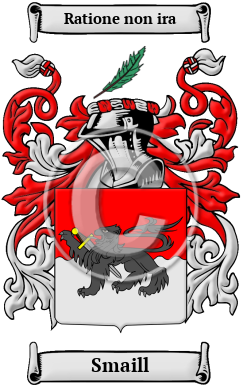
The motto was originally a war cry or slogan. Mottoes first began to be shown with arms in the 14th and 15th centuries, but were not in general use until the 17th century. Thus the oldest coats of arms generally do not include a motto. Mottoes seldom form part of the grant of arms: Under most heraldic authorities, a motto is an optional component of the coat of arms, and can be added to or changed at will; many families have chosen not to display a motto.
Motto: Ratione non ira
Motto Translation: By reason, not by rage.
- New Zealand Yesteryears Passenger Lists 1800 to 1900 (Retrieved 26th March 2019). Retrieved from http://www.yesteryears.co.nz/shipping/passlist.html
 |