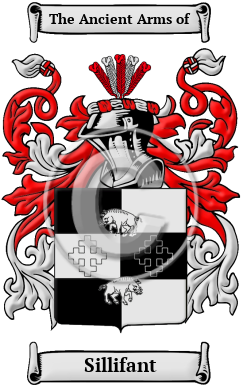
All Irish surnames have a long, ancient Gaelic history behind them. The original Gaelic form of the name Sillifant is Ó Suileabhain, which is partially derived from the word "suil," which means "eye." The surname probably means either one-eyed or hawk-eyed.
Loading...
Early Origins of the Sillifant family
The surname Sillifant was first found in County Kerry (Irish:Ciarraí) part of the former County Desmond (14th-17th centuries), located in Southwestern Ireland, in Munster province, where they held a family seat from ancient times at the Castle of Ardea, where their name was Sullivan.
Early History of the Sillifant family
This web page shows only a small excerpt of our Sillifant research. Another 81 words (6 lines of text) covering the years 1641 and 1921 are included under the topic Early Sillifant History in all our PDF Extended History products and printed products wherever possible.
Sillifant Spelling Variations
Because early scribes and church officials often spelled names as they sounded, a person could have many various spellings of his name.Many different spelling variations of the surname Sillifant were found in the archives researched. These included Sylliphant, Silliphant, Syliphant, Siliphant and others.
Early Notables of the Sillifant family
More information is included under the topic Early Sillifant Notables in all our PDF Extended History products and printed products wherever possible.
Loading...
Loading...
Loading...
Loading...
Migration of the Sillifant family
In the 18th and 19th centuries, thousands of Irish families fled an Ireland that was forcibly held through by England through its imperialistic policies. A large portion of these families crossed the Atlantic to the shores of North America. The fate of these families depended on when they immigrated and the political allegiances they showed after they arrived. Settlers that arrived before the American War of Independence may have moved north to Canada at the war's conclusion as United Empire Loyalists. Such Loyalists were granted land along the St. Lawrence River and the Niagara Peninsula. Those that fought for the revolution occasionally gained the land that the fleeing Loyalist vacated. After this period, free land and an agrarian lifestyle were not so easy to come by in the East. So when seemingly innumerable Irish immigrants arrived during the Great Potato Famine of the late 1840s, free land for all was out of the question. These settlers were instead put to work building railroads, coal mines, bridges, and canals. Whenever they came, Irish settlers made an inestimable contribution to the building of the New World. Early North American immigration records have revealed a number of people bearing the Irish name Sillifant or a variant listed above, including: D. Siliphant landed in America in 1840.