| ![Show Contents]() Shevill History, Family Crest & Coats of Arms Shevill History, Family Crest & Coats of Arms
- Origins Available:
England
Etymology of ShevillWhat does the name Shevill mean? The ancestry of the name Shevill dates from the ancient Anglo-Saxon culture of Britain. It comes from when the family lived in the town of Sheffield in the West Riding of Yorkshire. 1 The surname Shevill is a habitation name which was originally derived from pre-existing names for towns, villages, parishes, or farmsteads. In this case the place-name Sheffield means open land by the River Sheaf, 2 a boundary river dividing Yorkshire from Derbyshire. 3 The place name dates back to the Domesday Book of 1086 where it was originally recorded as Scafeld. 4 Early Origins of the Shevill familyThe surname Shevill was first found in Staffordshire where William de Shefeld was listed in the Assize Rolls of 1227. Years later, Thomas de Sheffeld was found in the Feet of Fines for Yorkshire in 1328 and in Oxfordshire, Ralph Sheffeld was recorded at Goring in 1456. 1 Back in Yorkshire, early records there show Will'us de Sheffeld in the Charter Rolls of 1307-1308. 2 Later, Johannes de Schefeld was recorded in the Yorkshire Poll Tax Rolls of 1379. 5 Early History of the Shevill familyThis web page shows only a small excerpt of our Shevill research. Another 120 words (9 lines of text) covering the years 1150, 1407, 1421, 1521, 1538, 1549, 1564, 1568, 1588, 1601, 1611, 1614, 1624, 1626, 1646, 1648, 1658, 1685, 1689, 1702, 1705 and 1721 are included under the topic Early Shevill History in all our PDF Extended History products and printed products wherever possible. Shevill Spelling VariationsSpelling variations in names were a common occurrence before English spelling was standardized a few hundred years ago. In the Middle Ages, even the literate spelled their names differently as the English language incorporated elements of French, Latin, and other European languages. Many variations of the name Shevill have been found, including Sheffield, Shefield, Sheffeild, Shiffield and many more. Early Notables of the Shevill familyWilliam Sheffield (fl. 1407-1421) English politician, Member of Parliament for Rutland; William Sheffield (died 1646), Member of Parliament for Hedon in 1614 and Thirsk in 1624; Edmund Sheffield (1521-1549), English nobleman, 1st Baron Sheffield of Butterwick; John Sheffield (c. 1538-1568), 2nd Baron Sheffield of Butterwick; Edmund Sheffield, 3rd Baron Sheffield (c. 1564-1646), created Earl...
Another 53 words (4 lines of text) are included under the topic Early Shevill Notables in all our PDF Extended History products and printed products wherever possible. Migration of the Shevill familyFamilies began migrating abroad in enormous numbers because of the political and religious discontent in England. Often faced with persecution and starvation in England, the possibilities of the New World attracted many English people. Although the ocean trips took many lives, those who did get to North America were instrumental in building the necessary groundwork for what would become for new powerful nations. Some of the first immigrants to cross the Atlantic and come to North America bore the name Shevill, or a variant listed above: Edmund, William, and Ichabod Sheffield settled in Portsmouth, New Hampshire in 1630; Thomas Sheffield and his wife, Rachel, settled in Virginia in 1622.
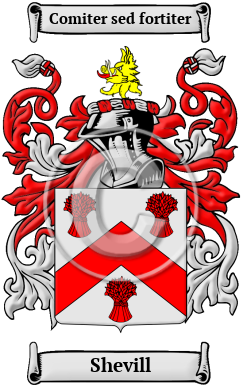
The motto was originally a war cry or slogan. Mottoes first began to be shown with arms in the 14th and 15th centuries, but were not in general use until the 17th century. Thus the oldest coats of arms generally do not include a motto. Mottoes seldom form part of the grant of arms: Under most heraldic authorities, a motto is an optional component of the coat of arms, and can be added to or changed at will; many families have chosen not to display a motto.
Motto: Comiter sed fortiter
Motto Translation: Courteously but firmly.
- Reaney, P.H and R.M. Wilson, A Dictionary of English Surnames. London: Routledge, 1991. Print. (ISBN 0-415-05737-X)
- Harrison, Henry, Surnames of the United Kingdom: A Concise Etymological Dictionary Baltimore: Geneological Publishing Company, 2013. Print
- Mills, A.D., Dictionary of English Place-Names. Oxford: Oxford University Press, 1991. Print. (ISBN 0-19-869156-4)
- Williams, Dr Ann. And G.H. Martin, Eds., Domesday Book A Complete Translation. London: Penguin, 1992. Print. (ISBN 0-141-00523-8)
- Bardsley, C.W, A Dictionary of English and Welsh Surnames: With Special American Instances. Wiltshire: Heraldry Today, 1901. Print. (ISBN 0-900455-44-6)
 |