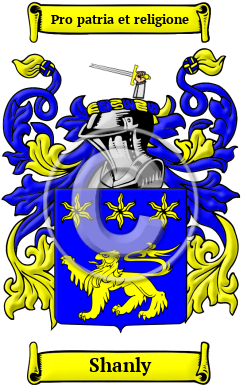
| ![Show Contents]() Shanly History, Family Crest & Coats of Arms Shanly History, Family Crest & Coats of Arms
Etymology of ShanlyWhat does the name Shanly mean? The family name Shanly has an intrinsic connection to the Gaelic culture of Ireland. This east Connacht sept gathered their original Gaelic form of the name Shanly is Mac Seanlaoich, which is derived from the words "sean," meaning "old," and "laoch," meaning "hero." Early Origins of the Shanly familyThe surname Shanly was first found in Leitrim (Irish: Liatroim) anciently the western half of the kingdom of Breifne, located in Northeastern Ireland, in Leinster province, where they held a family seat in that county, some say, well before the 10th century. Early History of the Shanly familyThis web page shows only a small excerpt of our Shanly research. Another 198 words (14 lines of text) covering the years 1404, 1473 and 1714 are included under the topic Early Shanly History in all our PDF Extended History products and printed products wherever possible. Shanly Spelling VariationsThroughout the early history of this name, spellings of the surname in various records changed frequently largely due to the recorder's interpretation of how the name sounded at the time of the entry. Spelling variations revealed in the search for the origin of the Shanly family name include Shanley, Shanly, MacShanley, McShanley, MacShanly and many more. Early Notables of the Shanly familyMore information is included under the topic Early Shanly Notables in all our PDF Extended History products and printed products wherever possible.
| Shanly migration to the United States | + |
Many Irish families did not fare so well within the English-ruled Ireland. Besides racial and religious discrimination, many families were renting out small tracts of farmland from absentee landowners at often unreasonable rates. Beginning in the late 18th century, moderately well off Irish families decided to emigrate to British North America or the United States in order to own their own plot of land. A radical change occurred in the 1840s, however, with the Great Potato Famine of the 1840s. Up to this point, the island's population had been increasing rapidly and a steady demand over the years for grain crops had depleted soil. Two failed crops and one poor one caused widespread disease and starvation. Thousands boarded ships looking for opportunities elsewhere. North America welcomed them as a source of cheap labor required for the many industrial and infrastructure projects underway, and as a means to quickly occupy the western regions. Research into immigration and passenger ship lists indicates that people bearing the name Shanly were among the earliest settlers to arrive in North America:
Shanly Settlers in United States in the 18th Century- Bernardo Shanly, who settled in Mississippi in 1789
Shanly Settlers in United States in the 19th Century- Christopher Shanly, who arrived in Philadelphia in 1820
- James Shanly, who arrived in New York in 1837
- James Shanly, who arrived in Mobile County, Ala in 1840 1
Shanly Settlers in United States in the 20th Century- Mary Shanly, aged 20, who settled in America from Longford, Ireland, in 1902
- Patrick Shanly, aged 22, who immigrated to the United States from Drumsna, in 1903
- Annie Shanly, aged 12, who landed in America from Leitrim, in 1903
- William Shanly, aged 21, who settled in America from Athlone, in 1905
- Michael Shanly, aged 21, who landed in America from Dromod, Ireland, in 1909
- ... (More are available in all our PDF Extended History products and printed products wherever possible.)
| Contemporary Notables of the name Shanly (post 1700) | + |
- Michael James Shanly (b. 1945), British multimillionaire businessman, founder of the Shanly Group, a housebuilder and commercial property investment firm
- Walter Shanly (1817-1899), Canadian civil engineer, author, businessman, and politician
- Charles Dawson Shanly (1811-1875), Canadian (Irish born), poet
The motto was originally a war cry or slogan. Mottoes first began to be shown with arms in the 14th and 15th centuries, but were not in general use until the 17th century. Thus the oldest coats of arms generally do not include a motto. Mottoes seldom form part of the grant of arms: Under most heraldic authorities, a motto is an optional component of the coat of arms, and can be added to or changed at will; many families have chosen not to display a motto.
Motto: Pro patria et religione
Motto Translation: For country and religion
- Filby, P. William, Meyer, Mary K., Passenger and immigration lists index : a guide to published arrival records of about 500,000 passengers who came to the United States and Canada in the seventeenth, eighteenth, and nineteenth centuries. 1982-1985 Cumulated Supplements in Four Volumes Detroit, Mich. : Gale Research Co., 1985, Print (ISBN 0-8103-1795-8)
 |