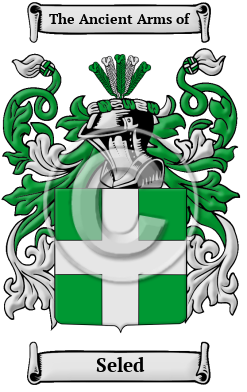
| ![Show Contents]() Seled History, Family Crest & Coats of Arms Seled History, Family Crest & Coats of Arms
Etymology of SeledWhat does the name Seled mean? The Seled family name is linked to the ancient Anglo-Saxon culture of Britain. Their name comes from the Old English given name Saulf. Seled is a patronymic surname, which belongs to the category of hereditary surnames. Many patronymic surnames were formed by adopting the given name of an ancestor of the bearer, while others came from popular religious names, and from the names of secular heroes. In this case, the surname arose out of the vernacular tradition, and was likely the name of an ancestor of the bearer. The given name Saulf was composed of the elements sæ and wulf, which mean sea and wolf. 1 Early Origins of the Seled familyThe surname Seled was first found in the Domesday Book of 1086 where Saiulfus, Sahulfus, Saulf, Saolf, Saul, Seulf are all listed. Robert filius Seulfi was listed as a Knights Templar in Berkshire in 1185 and later William Sewolf was found in the Subsidy Rolls for Sussex in 1296. John and William Self were found in the Subsidy Rolls for Suffolk in 1327. 2 "The name Sewlf (sea-wolf) occurs in a charter of Canute, and it is probably the same as the Saulf in the Domesday of Derbyshire, where it is in the Scandinavian form. Hence may be our Salve, Self, Selves." 3 4 In Yorkshire, the Poll Tax Rolls of 1379 included: Cristiana del Schelf, 1379; and Johannes de Schelf. 5 Early History of the Seled familyThis web page shows only a small excerpt of our Seled research. Another 101 words (7 lines of text) covering the year 1086 is included under the topic Early Seled History in all our PDF Extended History products and printed products wherever possible. Seled Spelling VariationsUntil the dictionary, an invention of only the last few hundred years, the English language lacked any comprehensive system of spelling rules. Consequently, spelling variations in names are frequently found in early Anglo-Saxon and later Anglo-Norman documents. One person's name was often spelled several different ways over a lifetime. The recorded variations of Seled include Self, Selfe and others. Early Notables of the Seled familyMore information is included under the topic Early Seled Notables in all our PDF Extended History products and printed products wherever possible. Migration of the Seled family to IrelandSome of the Seled family moved to Ireland, but this topic is not covered in this excerpt. More information about their life in Ireland is included in all our PDF Extended History products and printed products wherever possible. Migration of the Seled familyThousands of English families boarded ships sailing to the New World in the hope of escaping the unrest found in England at this time. Although the search for opportunity and freedom from persecution abroad took the lives of many because of the cramped conditions and unsanitary nature of the vessels, the opportunity perceived in the growing colonies of North America beckoned. Many of the settlers who survived the journey went on to make important contributions to the transplanted cultures of their adopted countries. The Seled were among these contributors, for they have been located in early North American records: Isaac Self settled in Pennsylvania in 1682; John Self settled in Pennsylvania in 1771; Samuel Self settled in Pennsylvania in 1771; William and Susan Selfe arrived in Barbados in 1654 but transferred to Virginia in the same year..
- Barber, Henry, British Family Names London: Elliot Stock, 62 Paternoster Row, 1894. Print.
- Reaney, P.H and R.M. Wilson, A Dictionary of English Surnames. London: Routledge, 1991. Print. (ISBN 0-415-05737-X)
- Charnock, Richard, Stephen, Ludus Patronymicus of The Etymology of Curious Surnames. London: Trubner & Co., 60 Paternoster Row, 1868. Print.
- Lower, Mark Anthony, Patronymica Britannica, A Dictionary of Family Names of the United Kingdom. London: John Russel Smith, 1860. Print.
- Bardsley, C.W, A Dictionary of English and Welsh Surnames: With Special American Instances. Wiltshire: Heraldry Today, 1901. Print. (ISBN 0-900455-44-6)
 |