| ![Show Contents]() Schots History, Family Crest & Coats of Arms Schots History, Family Crest & Coats of Arms
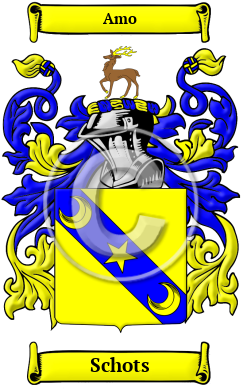
Etymology of SchotsWhat does the name Schots mean? Schots was first used as a surname by the descendents of the Boernician clans of Scotland. The Schots family lived in Roxburgh (now part of the region of Borders), Scotland. The surname Scott is of local origin as it denotes one who came from Scotland as in the Scot. The double 't' in Scott is now universal. Other records claim the name was for someone in England, who came to be from Scotland. Pre-dating surnames, the name may have been used for a Gaelic speaker within Scotland, who arrived with the Gaelic Dalriadans from Ireland in around 500 AD. Schots Coat of Arms CreationThe crest of Scott of Dunninald is a lion's head. There are two mottoes, " Tace aut face " (Be silent or do), and " Spe vires augentur " (Strength is increased by hope). This branch of the Scotts is descended from Michael Scott, the wizard. Another Scott has a flaming beacon as his crest, and the motto, " Regi fidelis patrice-que " (Faithful to King and country). Another has as a crest an arm holding in the hand a scroll, and yet another has a crescent, from which is seen issuing a bee, and the motto, " Invitum sequitur honor " (Honour follows though unsought). None of the Scotts now has as a crest a mural crown, from which issue six horsemen's lances with pennons, though that crest was given by James V. to John Scott of Thirlestane, who led three score and ten " Launciers " on horseback, willing to go with that King to England when all the nobles and others refused, and the King's letter to the Lion Herald says, " To give and to grant to John Scott an bundle of launces above his helmet with the words Ready aye ready ' as a token of our goodwill and kindness for his true worthiness." Why do none of the Scotts have this crest now ? The Duke of Buccleuch is a Scott. His crest is a stag tripping. The motto is " Amo " (I love), which was assumed by his predecessor when he got his first estate by marrying the heiress of Murdistoun. The shield shows the alliances made with the Douglas and Mar families. 1 Early Origins of the Schots familyThe surname Schots was first found in Roxburghshire, where a family seat was held on the lands of Ballendan at the head of the Ale water in that county. They descended from Uchtredus Scott who held the lands before 1107; he is on record as a witness to the foundation charter of Selkirk in 1120. Another early record is of Henricus le Scotte, who witnessed a charter by David Earl of Strathearn around 1195. By 1200, this great Clan controlled the Borderlands of the Middle Marches of West Teviotdale, Ewesdale, Liddesdale, Buccleuch and Balweariel. 2 Early History of the Schots familyThis web page shows only a small excerpt of our Schots research. Another 212 words (15 lines of text) covering the years 1296, 1450, 1565, 1611, 1644, 1647, 1649, 1661, 1674, 1685, 1693, 1705, 1745, 1771, 1832 and 1890 are included under the topic Early Schots History in all our PDF Extended History products and printed products wherever possible. Schots Spelling VariationsScribes in the Middle Ages simply spelled according to sound. The result is an enormous number of spelling variations among names that evolved in that era. Schots has been spelled Scott, Scot, Skotts, Scot, Scotach, Scott, Schotts and many more. Early Notables of the Schots familyWalter Scott of Buccleuch (1565-1611), a Scottish nobleman and famous border reiver, known as the "Bold Buccleuch"; Mary Scott, 3rd Countess of Buccleuch and Countess of Tarras (1647-1661) Scottish peeress who married at the age of 11; Walter Scott, 1st Earl of Tarras (1644-1693), a Scottish nobleman who married the aforementioned Mary Scott when he was 14; James...
Another 58 words (4 lines of text) are included under the topic Early Schots Notables in all our PDF Extended History products and printed products wherever possible. Migration of the Schots family to IrelandSome of the Schots family moved to Ireland, but this topic is not covered in this excerpt.
Another 55 words (4 lines of text) about their life in Ireland is included in all our PDF Extended History products and printed products wherever possible. Migration of the Schots familyMost of the Boernician-Scottish families who came to North America settled on the eastern seaboard of what would become the United States and Canada. Families who wanted a new order stayed south in the War of Independence, while those who were still loyal to the crown went north to Canada as United Empire Loyalists. In the 20th century, the ancestors of these families have gone on to rediscover their heritage through Clan societies and other patriotic Scottish organizations. Research into the origins of individual families in North America has revealed records of the immigration of a number of people bearing the name Schots or a variant listed above: Nicholas Scot, who arrived in Virginia in 1606, fourteen years before the "Mayflower"; Elizabeth Scot settled in Barbados in 1667; Goodwife Scott arrived in Virginia in 1623.
| Historic Events for the Schots family | + |
- Mr. A P Schots (d. 1979), Dutch passenger from The Netherlands, who flew aboard American Airlines Flight 191 and died in the crash 3
- Mrs W E Schots (d. 1979), Dutch passenger from The Netherlands, who flew aboard American Airlines Flight 191 and died in the crash 4
The motto was originally a war cry or slogan. Mottoes first began to be shown with arms in the 14th and 15th centuries, but were not in general use until the 17th century. Thus the oldest coats of arms generally do not include a motto. Mottoes seldom form part of the grant of arms: Under most heraldic authorities, a motto is an optional component of the coat of arms, and can be added to or changed at will; many families have chosen not to display a motto.
Motto: Amo
Motto Translation: I love
- Polson, Alexander, The Romance of Scottish Crests and Mottoes. Inverness: Walter Alexander, Inglis Street 1929. Print
- Black, George F., The Surnames of Scotland Their Origin, Meaning and History. New York: New York Public Library, 1946. Print. (ISBN 0-87104-172-3)
- Flight 191's Victims - latimes. (Retrieved 2014, April 16) . Retrieved from http://articles.latimes.com/1985-08-04/news/mn-4349_1_fort-lauderdale-area
 |