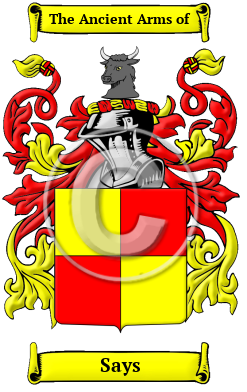
| ![Show Contents]() Says History, Family Crest & Coats of Arms Says History, Family Crest & Coats of Arms
Etymology of SaysWhat does the name Says mean? Says is a name that came to England in the 11th century wave of migration that was set off by the Norman Conquest of 1066. The Says family lived in Shropshire. "Cil de Saie," mentioned by Wace in his account of the Battle of Hastings, took his name from the vill of Saium or Say, about nine miles to the west of Exmes, the caput of Roger de Montgomeri's Norman Viscountcy, and held under Roger in Normandy, as he afterwards did in England. He is known as Picot de Say. Within thirty years of Domesday, Theodoric de Say, a cadet of the Barons of Clun, was enfeoffed by Roger de Lacy of Stoke, afterwards called Stokesay. One of his descendants, Hugh II., was possessed of Moreton Say as early as 1243, and about 1250 exchanged Stokesay with his suzerain, John de Verdon, for some property in Ireland, where he took up his abode. Robert de Say held Moreton Say in 1255, and, with William de Say, had summons to attend a great Council at Westminster. Roger de Say, in 1203, was a tenant of Robert de Buller's at Hope Bowdler and Amaston and left Lucia and Amice his co-heirs. Then we have Eustachia de Say, co-foundress of Westwood in Worcestershire, who, in the time of Henry I., married Hugh Fitz Osborn, Baron of Burford and Richard's Castle, "Most accounts," says Eyton, "would induce us to associate her with the Barons of Clun or the Lords of Stokesay. 1 Early Origins of the Says familyThe surname Says was first found in Shropshire but the first record of the name was Geoffrey de Saye, Lord of West Greenwich (1135-1214.) His son, Geoffrey de Saye, II (died 1230), Lord of West Greenwich was born in 1155 in West Greenwich, Kent and died in Gascoigne, Poitou, France. His son was Geoffrey de Saye (1155-1230), was an English nobleman, and Magna Carta surety who held lands at Edmonton (now part of London) and Sawbridgeworth (a small town and civil parish in Hertfordshire.) 2 "Picot de Say was, in the time of the Conqueror, one of the principal persons in the county of Salop, under Roger de Montgomery, Earl of Shrewsbury, and founded the distinguished Baronial House of Say, from which derives, through female descent, the Lord Saye and Sele." 3 Geoffrey de Say, Baron de Say (ca. 1305-1359), was the second Baron by writ and a descendant of William de Say. 4 Stratfield Saye is a village and civil parish in Hampshire that includes the hamlets of West End Green, Fair Oak Green and Fair Cross. 5 Early History of the Says familyThis web page shows only a small excerpt of our Says research. Another 106 words (8 lines of text) covering the years 1214, 1382, 1404, 1420, 1468, 1478, 1604, 1632, 1649, 1653, 1656, 1661, 1664, 1665, 1666, 1676, 1681, 1685, 1691, 1692 and 1743 are included under the topic Early Says History in all our PDF Extended History products and printed products wherever possible. Says Spelling VariationsThe English language only became standardized in the last few centuries. For that reason, spelling variations are common among many Anglo-Norman names. The shape of the English language was frequently changed with the introduction of elements of Norman French, Latin, and other European languages; even the spelling of literate people's names were subsequently modified. Says has been recorded under many different variations, including Say, Saye, Sais and others. Early Notables of the Says familySir John Say (d. 1478), Speaker of the House of Commons, is doubtfully said to have been the son of John Heron (d. 1468), son of Sir John Heron (d. 1420), nephew and heir of Sir William Heron (d. 1404). The last-named was styled Lord Say in right of his wife Elizabeth, sister and heir of John de Say, Baron Say (d. 1382.) 4
Evan Seys (1604-1685), was a Welsh lawyer from Swansea, Glamorgan, Attorney General under Oliver Cromwell, Recorder of Gloucester in 1649, Member of Parliament for Gloucester (1661-1681); and Robert Say D.D. (died 1691), was an English academic administrator at...
Another 116 words (8 lines of text) are included under the topic Early Says Notables in all our PDF Extended History products and printed products wherever possible.
| Says migration to the United States | + |
To escape the uncertainty of the political and religious uncertainty found in England, many English families boarded ships at great expense to sail for the colonies held by Britain. The passages were expensive, though, and the boats were unsafe, overcrowded, and ridden with disease. Those who were hardy and lucky enough to make the passage intact were rewarded with land, opportunity, and social environment less prone to religious and political persecution. Many of these families went on to be important contributors to the young nations of Canada and the United States where they settled. Sayss were some of the first of the immigrants to arrive in North America:
Says Settlers in United States in the 17th Century- James Says, who arrived in Massachusetts in 1634
- Mary Says, who settled in Massachusetts in 1638
- Elizabeth Says, who settled in Massachusetts in 1638
- Thomas Says, who landed in Massachusetts in 1639 6
- Cleveland, Dutchess of The Battle Abbey Roll with some Account of the Norman Lineages. London: John Murray, Abermarle Street, 1889. Print. Volume 3 of 3
- The Norman People and Their Existing Descendants in the British Dominions and the United States Of America. Baltimore: Genealogical Publishing, 1975. Print. (ISBN 0-8063-0636-X)
- Burke, John Bernard, The Roll of Battle Abbey. London: Edward Churton, 26, Holles Street, 1848, Print.
- Smith, George (ed), Dictionary of National Biography. London: Smith, Elder & Co., 1885-1900. Print
- Lewis, Samuel, A Topographical Dictionary of England. Institute of Historical Research, 1848, Print.
- Filby, P. William, Meyer, Mary K., Passenger and immigration lists index : a guide to published arrival records of about 500,000 passengers who came to the United States and Canada in the seventeenth, eighteenth, and nineteenth centuries. 1982-1985 Cumulated Supplements in Four Volumes Detroit, Mich. : Gale Research Co., 1985, Print (ISBN 0-8103-1795-8)
 |