
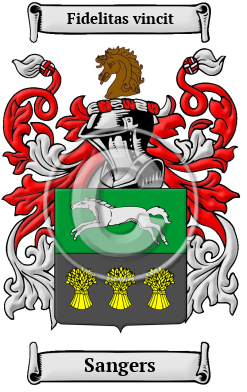
Show ContentsSangers History, Family Crest & Coats of Arms

Etymology of Sangers

What does the name Sangers mean?

The name Sangers is Anglo-Saxon in origin. It was a name given to a person who was a singaere or musician. During the Middle Ages people were identified by the type of work one did and were referred to in this manner. The traveling musician was therefore named the singaere, and was a well known and respected figure in medieval times. He was the main entertainer at fairs and festivals and was also a source of news and idle gossip from the neighboring towns.

Early Origins of the Sangers family

The surname Sangers was first found in Devon where one of the first records of the name was Lucas le Syngere who was listed in the Subsidy Rolls of 1296. The same rolls listed William le Syngur one year later in Yorkshire.

Early History of the Sangers family

This web page shows only a small excerpt of our Sangers research. Another 123 words (9 lines of text) covering the years 1400, 1594, 1602, 1678 and 1811 are included under the topic Early Sangers History in all our PDF Extended History products and printed products wherever possible.

Sangers Spelling Variations

Until the dictionary, an invention of only the last few hundred years, the English language lacked any comprehensive system of spelling rules. Consequently, spelling variations in names are frequently found in early Anglo-Saxon and later Anglo-Norman documents. One person's name was often spelled several different ways over a lifetime. The recorded variations of Sangers include Singer, Singers, Singar and others.

Early Notables of the Sangers family

John Singer (fl. 1594-1602), an English actor and dramatist who was with Queen Elizabeth's company and the Admiral's (Lord Charles Howard, earl of Nottingham) at the Rose Theatre from...
Another 28 words (2 lines of text) are included under the topic Early Sangers Notables in all our PDF Extended History products and printed products wherever possible.


Sangers migration to Australia +

Sangers Settlers in Australia in the 19th Century
  • Mr. William Henry Sangers, English convict who was convicted in Norfolk, England for life, transported aboard the "Blundell" on 13th March 1844, arriving in Tasmania (Van Diemen's Land) 1


The Sangers Motto +

The motto was originally a war cry or slogan. Mottoes first began to be shown with arms in the 14th and 15th centuries, but were not in general use until the 17th century. Thus the oldest coats of arms generally do not include a motto. Mottoes seldom form part of the grant of arms: Under most heraldic authorities, a motto is an optional component of the coat of arms, and can be added to or changed at will; many families have chosen not to display a motto.

Motto: Fidelitas vincit
Motto Translation: Fidelity prevails.


  1. Convict Records Voyages to Australia (Retrieved 25th October 2020). Retrieved from https://convictrecords.com.au/ships/blundell


Houseofnames.com on Facebook