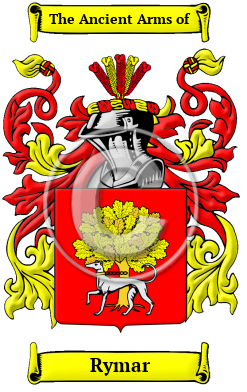
| ![Show Contents]() Rymar History, Family Crest & Coats of Arms Rymar History, Family Crest & Coats of Arms
Etymology of RymarWhat does the name Rymar mean? The name Rymar is rooted in the ancient Anglo-Saxon culture. It was originally a name for someone who worked as a person who had the gift of poetry as in "the ryhmer, poet versifier, singer" 1 and as such came from a variety of places throughout the United Kingdom. Probably the most famous of the name in early records was Thomas of Erceldoune, sometimes styled Thomas Learmonth (fl. c. 1220-1298), a Scottish laird in Berwickshire and reputed prophet who was known by the sobriquets Thomas the Rhymer or True Thomas. 2 According to tradition, Thomas the Rhymer, was carried off by the "Queen of Elfland" and returned having gained the gift of prophecy, as well as the inability to tell a lie. The story appears in at least five manuscripts and as the protagonist in the popular ballad "Thomas the Rhymer." The name denoted "doubtless a person skilled in making verses, like the far-famed Scotchman, Thomas the Rhymer. King Henry II. kept a court poet, or poet-laureate, called Master Henry the Versifier, and paid him one hundred shillings per annum for his poesy. Still earlier, Henry I. had a bard who wrote laudatory verses about his master, and was called Walo Versificator." 3 Early Origins of the Rymar familyThe surname Rymar was first found in Suffolk and Berwick, Scotland. Early rolls list Warin Rymer in Yorkshire in 1229; and Richard le Rimour in Lancashire in 1277. 4 "The Rymers of Chepstow and its vicinity are probably connected with a family of clothiers, called Rimer, who lived in Minchin Hampton early last century." 5 Early History of the Rymar familyThis web page shows only a small excerpt of our Rymar research. Another 102 words (7 lines of text) covering the years 1296, 1641, 1643, 1663 and 1713 are included under the topic Early Rymar History in all our PDF Extended History products and printed products wherever possible. Rymar Spelling VariationsIt is only in the last few hundred years that the English language has been standardized. For that reason, early Anglo-Saxon surnames like Rymar are characterized by many spelling variations. As the English language changed and incorporated elements of other European languages, even literate people changed the spelling of their names. The variations of the name Rymar include Rymour, Rymer, Rymor, Rhymer and others. Early Notables of the Rymar familyRalph Rymer, Lord of the Manor of Brafferton in Yorkshire, executed for his part in the Farnley Wood Plot of 1663; and his son, Thomas Rymer (1641-1713), English, writer, critic, historiographer and Poet Laureate. He was born...
Another 36 words (3 lines of text) are included under the topic Early Rymar Notables in all our PDF Extended History products and printed products wherever possible. Migration of the Rymar familyMany English families tired of political and religious strife left Britain for the new colonies in North America. Although the trip itself offered no relief - conditions on the ships were extremely cramped, and many travelers arrived diseased, starving, and destitute - these immigrants believed the opportunities that awaited them were worth the risks. Once in the colonies, many of the families did indeed prosper and, in turn, made significant contributions to the culture and economies of the growing colonies. An inquiry into the early roots of North American families has revealed a number of immigrants bearing the name Rymar or a variant listed above: George Rymer settled in New England in 1772; Martha Rymer settled with her husband in Rapahanock in Virginia in 1729.
- Bardsley, C.W, A Dictionary of English and Welsh Surnames: With Special American Instances. Wiltshire: Heraldry Today, 1901. Print. (ISBN 0-900455-44-6)
- Black, George F., The Surnames of Scotland Their Origin, Meaning and History. New York: New York Public Library, 1946. Print. (ISBN 0-87104-172-3)
- Lower, Mark Anthony, Patronymica Britannica, A Dictionary of Family Names of the United Kingdom. London: John Russel Smith, 1860. Print.
- Reaney, P.H and R.M. Wilson, A Dictionary of English Surnames. London: Routledge, 1991. Print. (ISBN 0-415-05737-X)
- Guppy, Henry Brougham, Homes of Family Names in Great Britain. 1890. Print.
 |