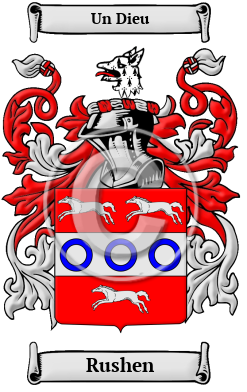
| ![Show Contents]() Rushen History, Family Crest & Coats of Arms Rushen History, Family Crest & Coats of Arms
Etymology of RushenWhat does the name Rushen mean? The ancestors of the bearers of the Rushen family name are thought have lived in ancient Anglo-Saxon England. They were first found near a clump of rushes. 1 The surname Rushen comes from the Old English word rush, which had the same meaning. Thus, bearers of the surname Rushen lived near a marsh, which was noted for its rushes. Another source claims that "there can be little doubt that Rush is a variant of Russ, as that is unquestionably of Rous. In the Index to Register of the University of Oxford., Rush and Russe are placed under one heading." 2 Early Origins of the Rushen familyThe surname Rushen was first found in Surrey where John atte Russh was listed in the Subsidy Rolls of 1332. 1 Early History of the Rushen familyThis web page shows only a small excerpt of our Rushen research. Another 115 words (8 lines of text) covering the years 1533, 1537, 1554, 1561, 1566, 1577, 1582, 1600, 1623, 1629, 1638, 1663, 1665, 1745, 1756, 1813, 1833 and 1890 are included under the topic Early Rushen History in all our PDF Extended History products and printed products wherever possible. Rushen Spelling VariationsUntil quite recently, the English language has lacked a definite system of spelling rules. Consequently, Anglo-Saxon surnames are characterized by a multitude of spelling variations. Changes in Anglo-Saxon names were influenced by the evolution of the English language, as it incorporated elements of French, Latin, and other languages. Although Medieval scribes and church officials recorded names as they sounded, so it is common to find one person referred to by several different spellings of his surname, even the most literate people varied the spelling of their own names. Variations of the name Rushen include Rush, Rushe and others. Early Notables of the Rushen familyAnthony Rush (1537-1577), English divine, Dean of Chichester, was apparently son and heir of Arthur Rush of Sudborne, Suffolk, and grandson of Sir Thomas Rush of that place, who was knighted in 1533 for his services to Henry VIII. 3
Dr. Benjamin Rush (1745-1813), was a Founding...
Another 46 words (3 lines of text) are included under the topic Early Rushen Notables in all our PDF Extended History products and printed products wherever possible. Migration of the Rushen family to IrelandSome of the Rushen family moved to Ireland, but this topic is not covered in this excerpt.
Another 286 words (20 lines of text) about their life in Ireland is included in all our PDF Extended History products and printed products wherever possible.
| Rushen migration to Australia | + |
Emigration to Australia included the Second Fleet of convicts, tradespeople and early settlers. Early immigrants include: Second Fleet - Mr. Richard Rushen, British settler convicted in Middlesex, England in 1790, sentenced to 7 years for stealing, transported aboard the ship "Third Fleet" leaving in 1790 arriving in New South Wales, Australia in 1791 4
| Contemporary Notables of the name Rushen (post 1700) | + |
- Patrice Louise Rushen (b. 1954), American Grammy Award nominated jazz pianist, R&B singer, record producer, multi-instrumentalist, songwriter, and music director, known for her 1982 single, "Forget Me Nots"
- Arthur Rushen (1884-1968), British gold medalist cyclist at the 1906 Intercalated Games, he later competed in one event at the 1908 Summer Olympics
- Rushen R. Jones (b. 1980), former professional American football player who played defensive back for the Minnesota Vikings (2003-2024)
| Historic Events for the Rushen family | + |
- Mr. Claude Eggleton Rushen (1889-1917), English Leading Seaman aboard the HMS Highflyer from Essex, England, United Kingdom who died in the Halifax Explosion (1917) 5
The motto was originally a war cry or slogan. Mottoes first began to be shown with arms in the 14th and 15th centuries, but were not in general use until the 17th century. Thus the oldest coats of arms generally do not include a motto. Mottoes seldom form part of the grant of arms: Under most heraldic authorities, a motto is an optional component of the coat of arms, and can be added to or changed at will; many families have chosen not to display a motto.
Motto: Un Dieu
Motto Translation: One God.
- Reaney, P.H and R.M. Wilson, A Dictionary of English Surnames. London: Routledge, 1991. Print. (ISBN 0-415-05737-X)
- Bardsley, C.W, A Dictionary of English and Welsh Surnames: With Special American Instances. Wiltshire: Heraldry Today, 1901. Print. (ISBN 0-900455-44-6)
- Smith, George (ed), Dictionary of National Biography. London: Smith, Elder & Co., 1885-1900. Print
- Convict Records of Australia. Retrieved 4th February 2021 from https://convictrecords.com.au/ships
- Halifax Explosion Book of Remembrance | Maritime Museum of the Atlantic. (Retrieved 2014, June 23) . Retrieved from https://maritimemuseum.novascotia.ca/what-see-do/halifax-explosion/halifax-explosion-book-remembrance
 |