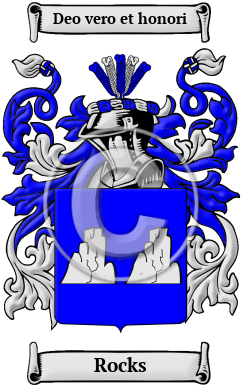
| ![Show Contents]() Rocks History, Family Crest & Coats of Arms Rocks History, Family Crest & Coats of Arms
Etymology of RocksWhat does the name Rocks mean? Languedoc is the region of ancient France from which the name Rocks was derived. It comes from when the family lived in La Rocque, in l'Herault, Languedoc. Early Origins of the Rocks familyThe surname Rocks was first found in Languedoc where the family has held a family seat since ancient times. Early History of the Rocks familyThis web page shows only a small excerpt of our Rocks research. Another 460 words (33 lines of text) covering the years 1090, 1112, 1132, 1280, 1303, 1372, 1500, 1541, 1550, 1581, 1582, 1620, 1704, 1709, 1746, 1760 and 1762 are included under the topic Early Rocks History in all our PDF Extended History products and printed products wherever possible. Rocks Spelling VariationsThere were a great number of spelling variations in French surnames. One reason for this was the wide variety of cultural influences present in France during the early development of the French language. The many spelling variations of the name include La Roque, Roque, De Roque, du Roque, Rocque, La Rocque, du Rocque, Larocque, Laroc, Roquebrune and many more. Early Notables of the Rocks familyJohn Rocque (1704-1762), originally Jean, a French-born British surveyor and cartographer, best known for his detailed map of London published in 1746. He was one of four children of a Huguenot family who subsequently...
Another 34 words (2 lines of text) are included under the topic Early Rocks Notables in all our PDF Extended History products and printed products wherever possible.
| Rocks migration to the United States | + |
By 1643 there were only about 300 people in Quebec. Since immigration was slow, early marriage was desperately encouraged amongst the immigrants. The fur trade attracted migrants, both noble and commoner. 15,000 explorers left Montreal in the late 17th and 18th centuries. By 1675, there were 7000 French in Quebec. By the same year the Acadian presence in Nova Scotia, New Brunswick and Prince Edward Island had reached 500. In 1755, 10,000 French Acadians refused to take an oath of allegiance to England and were deported to Louisiana. The French founded Lower Canada, thus becoming one of the two great founding nations of Canada. The distinguished family name Rocks has made significant contributions to the culture, arts, sciences and religion of France and New France. Amongst the settlers in North America with this distinguished name Rocks were
Rocks Settlers in United States in the 17th Century- Anth Rocks, who landed in Virginia in 1642 1
Rocks Settlers in United States in the 18th Century- Anna Margaret Rocks, aged 24, who landed in New York in 1710 1
| Rocks migration to Australia | + |
Rocks Settlers in Australia in the 19th Century- Mr. James Rocks, (Rox, Ross), Scottish convict who was convicted in Stirling, Scotland for 10 years, transported aboard the "Barossa" on 8th December 1839, arriving in New South Wales, Australia 2
- Charles Rocks, who arrived in Adelaide, Australia aboard the ship "Posthumous" in 1849 3
| Rocks migration to West Indies | + |
The British first settled the British West Indies around 1604. They made many attempts but failed in some to establish settlements on the Islands including Saint Lucia and Grenada. By 1627 they had managed to establish settlements on St. Kitts (St. Christopher) and Barbados, but by 1641 the Spanish had moved in and destroyed some of these including those at Providence Island. The British continued to expand the settlements including setting the First Federation in the British West Indies by 1674; some of the islands include Barbados, Bermuda, Cayman Island, Turks and Caicos, Jamaica and Belize then known as British Honduras. By the 1960's many of the islands became independent after the West Indies Federation which existed from 1958 to 1962 failed due to internal political conflicts. After this a number of Eastern Caribbean islands formed a free association. 4Rocks Settlers in West Indies in the 17th Century- Mr. Michell Rocks aged 21, British settler travelling from Gravesend, UK aboard the ship "Hopewell" arriving in Barbados on 17th February 1634 1
| Contemporary Notables of the name Rocks (post 1700) | + |
- M. Joseph Rocks, American Republican politician, Member of Pennsylvania State Senate 4th District, 1981-90; Candidate for Mayor of Philadelphia, Pennsylvania, 1995
The motto was originally a war cry or slogan. Mottoes first began to be shown with arms in the 14th and 15th centuries, but were not in general use until the 17th century. Thus the oldest coats of arms generally do not include a motto. Mottoes seldom form part of the grant of arms: Under most heraldic authorities, a motto is an optional component of the coat of arms, and can be added to or changed at will; many families have chosen not to display a motto.
Motto: Deo vero et honori
Motto Translation: God and the honor
- Filby, P. William, Meyer, Mary K., Passenger and immigration lists index : a guide to published arrival records of about 500,000 passengers who came to the United States and Canada in the seventeenth, eighteenth, and nineteenth centuries. 1982-1985 Cumulated Supplements in Four Volumes Detroit, Mich. : Gale Research Co., 1985, Print (ISBN 0-8103-1795-8)
- Convict Records Voyages to Australia (Retrieved 24th September 2020). Retrieved from https://convictrecords.com.au/ships/barossa
- State Records of South Australia. (Retrieved 2010, November 5) The POSTHUMOUS 1849. Retrieved from http://www.slsa.sa.gov.au/BSA/1849Posthumous.htm
- https://en.wikipedia.org/wiki/British_West_Indies
 |