| ![Show Contents]() Reide History, Family Crest & Coats of Arms Reide History, Family Crest & Coats of Arms
- Origins Available:
Scotland
Ireland
Early Origins of the Reide familyThe surname Reide was first found in Angus (Gaelic: Aonghas), part of the Tayside region of northeastern Scotland, and present day Council Area of Angus, formerly known as Forfar or Forfarshire, where they held a family seat from early times and their first records appeared on the early census rolls taken by the early Kings of Britain to determine the rate of taxation of their subjects. Early History of the Reide familyThis web page shows only a small excerpt of our Reide research. Another 73 words (5 lines of text) covering the year 1681 is included under the topic Early Reide History in all our PDF Extended History products and printed products wherever possible. Reide Spelling VariationsSpelling variations of this family name include: Reddy, Reddie, Readdie, Reedie, Reidie and others. Early Notables of the Reide familyMore information is included under the topic Early Reide Notables in all our PDF Extended History products and printed products wherever possible. Migration of the Reide family to IrelandSome of the Reide family moved to Ireland, but this topic is not covered in this excerpt. More information about their life in Ireland is included in all our PDF Extended History products and printed products wherever possible.
| Reide migration to the United States | + |
Reide Settlers in United States in the 17th Century- John Reide, who landed in Maryland in 1679 1
Reide Settlers in United States in the 18th Century- Malcolm Reide, who arrived in South Carolina in 1716 1
| Reide migration to Canada | + |
Reide Settlers in Canada in the 18th Century- Mr. George Reide U.E. who settled in Home District [York County], Ontario c. 1786 he served in Butlers Rangers, married with one child 2
- Mr. William Reide U.E. who settled in Home District [York County], Ontario c. 1786 he served in Butlers Rangers, was taken prisoner 2
- Capt. William Reide U.E. who settled in Yonge [Front of Yonge], United Counties of Leeds and Grenville, Ontario c. 1786 he served in the Militia South Carolina 2
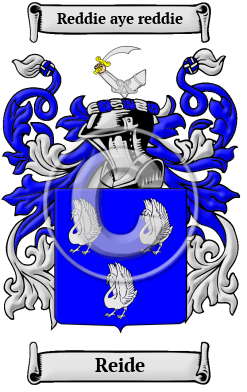
The motto was originally a war cry or slogan. Mottoes first began to be shown with arms in the 14th and 15th centuries, but were not in general use until the 17th century. Thus the oldest coats of arms generally do not include a motto. Mottoes seldom form part of the grant of arms: Under most heraldic authorities, a motto is an optional component of the coat of arms, and can be added to or changed at will; many families have chosen not to display a motto.
Motto: Reddie aye reddie
- Filby, P. William, Meyer, Mary K., Passenger and immigration lists index : a guide to published arrival records of about 500,000 passengers who came to the United States and Canada in the seventeenth, eighteenth, and nineteenth centuries. 1982-1985 Cumulated Supplements in Four Volumes Detroit, Mich. : Gale Research Co., 1985, Print (ISBN 0-8103-1795-8)
- Rubincam, Milton. The Old United Empire Loyalists List. Genealogical Publishing Co., Inc, 1976. (Originally published as; United Empire Loyalists. The Centennial of the Settlement of Upper Canada. Rose Publishing Company, 1885.) ISBN 0-8063-0331-X
 |