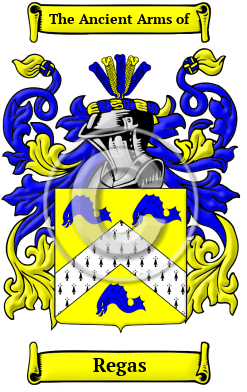
| ![Show Contents]() Regas History, Family Crest & Coats of Arms Regas History, Family Crest & Coats of Arms
- Origins Available:
Ireland
Etymology of RegasWhat does the name Regas mean? Irish surnames are linked to the long Gaelic heritage of the Island nation. The original Gaelic form of the name Regas is Ó Riagain. In County Waterford, the Gaelic form Ó Reagain is used. Early Origins of the Regas familyThe surname Regas was first found in County Meath (Irish: An Mhí) anciently part of the kingdom of Brega, located in Eastern Ireland, in the province of Leinster, where they held a family seat from very ancient times. One of the oldest records of the family was Morice Regan (fl. 1171), an Irish interpreter. He is stated in an old French poem, of which the only text begins 'Par soen demeine latimer.' He is thought to have acted as an interpreter and herald, or envoy in the service of Diarmaid MacMurchada, King of Leinster. 1 Early History of the Regas familyThis web page shows only a small excerpt of our Regas research. Another 137 words (10 lines of text) covering the year 1172 is included under the topic Early Regas History in all our PDF Extended History products and printed products wherever possible. Regas Spelling VariationsIrish names recorded during the Middle Ages are characterized by many spelling variations. This preponderance of variations for common names can be explained by the fact that the scribes and church officials that kept records during that period individually decided how to capture one's name. These recorders primarily based their decisions on how the name was pronounced or what it meant. Research into the name Regas revealed many variations, including Reagan, Regan, O'Regan, O'Reagan and others. Early Notables of the Regas familyMore information is included under the topic Early Regas Notables in all our PDF Extended History products and printed products wherever possible. Migration of the Regas familyUnder the rule of England, land ownership in Ireland changed dramatically, and many native Irish families found themselves renting out land to farm from absentee owners. This was one of the prime reasons that immigration to North America began in the late 18th century: Irish farmers dreamed of owning their own parcel of land to work for themselves. At this point, the immigrants were at least of modest means for the passage across the Atlantic was often quite dear. In the 1840s the Great Potato Famine created an exodus of people of quite different means. These people were most often destitute: they either sold anything they had to gain a passage or they were sponsored by philanthropic societies. Many of these immigrants were sick from disease and starvation: as a result many did not survive the long transatlantic journey. Although those settlers that did survive were often despised and discriminated against by people already established in these nations, they were critical to rapid development of the powerful industrial nations of the United States and the country that would later become known as Canada. An examination of immigration and passenger lists shows many persons bearing the name of Regas or one of its variants: John Regan, who settled with his wife and three children in Prescott, Ontario, Canada, in 1825; James, John, Patrick, Thomas and William O'Regan, who all arrived at Philadelphia between 1840 and 1860.
| Contemporary Notables of the name Regas (post 1700) | + |
- George Frank Regas (1930-2021), American Episcopal priest who served as rector of All Saints Episcopal Church, Pasadena, California, from 1967 until his retirement in 1995
- Rosa Regàs (1933-2024), Spanish writer and novelist, recipient of the Premio Planeta de Novela and the Premio Nadal
- Smith, George (ed), Dictionary of National Biography. London: Smith, Elder & Co., 1885-1900. Print
 |