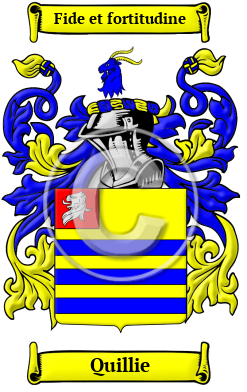
In Ireland, the name Quillie is generally derived from the Gaelic "Mac an Choiligh," which means "son of the cock or rooster;" the name was often Anglicized as Cox.
Loading...
Early Origins of the Quillie family
The surname Quillie was first found in County Roscommon (Irish: Ros Comáin) located in central Ireland in the province of Connacht, where they held a family seat from ancient times.
Early History of the Quillie family
This web page shows only a small excerpt of our Quillie research. Another 87 words (6 lines of text) covering the years 1558, 1650, 1675, 1733, 1770 and 1837 are included under the topic Early Quillie History in all our PDF Extended History products and printed products wherever possible.
Quillie Spelling Variations
Individual scribes in the Ireland during the Middle Ages would often record a person's name various ways. How the name was recorded depended on what that particular scribe believed the proper spelling for the name pronounced to him was. Spelling variations revealed in the search for the origin of the Quillie family name include MacQuilly, McQuilly, MacQuilley, McQuilly, MacQuillie, McQuillie, Quilley, Quilly, Quillie, Cox, Coxe and many more.
Early Notables of the Quillie family
Another 38 words (3 lines of text) are included under the topic Early Quillie Notables in all our PDF Extended History products and printed products wherever possible.
Loading...
Loading...
Loading...
Loading...
Migration of the Quillie family
The English-ruled Ireland of the late 18th and 19th centuries featured a rapidly increasing population and an agricultural-based economy. This combination proved to be disastrous in the 1840s after a couple of failed potato harvests. Thousands died of disease and starvation, and thousands more left the country, often bound for North America. Those that survived the journey to North America were put to work building the bridges, canals, roadways, and railways needed for the development of an industrial society. Those Irish, although often despised by those already established in North American cities and towns, played an instrumental role in making Canada and the United States the powerful and wealthy nations that they are today. An examination of early immigration and passenger lists has shown many immigrants bearing the name Quillie: William McQuillie who landed in Philadelphia, Pennsylvania in 1804; Thomas Cox, who arrived in New York, NY in 1805; Andrew Cox, who arrived in Quebec in 1850.
The motto was originally a war cry or slogan. Mottoes first began to be shown with arms in the 14th and 15th centuries, but were not in general use until the 17th century. Thus the oldest coats of arms generally do not include a motto. Mottoes seldom form part of the grant of arms: Under most heraldic authorities, a motto is an optional component of the coat of arms, and can be added to or changed at will; many families have chosen not to display a motto.
Motto: Fide et fortitudine Motto Translation: By fidelity and fortitude.
Remove Item
WARNING!
Removing this item from your shopping cart will remove your associated sale items.
Are you sure you want to delete this item from your shopping cart?