| ![Show Contents]() Quilkin History, Family Crest & Coats of Arms Quilkin History, Family Crest & Coats of Arms
Etymology of QuilkinWhat does the name Quilkin mean? The name Quilkin was brought to England in the great wave of migration following the Norman Conquest of 1066. It comes from the Norman personal name Wilkins, which in turn is derived from the name William. William, which is derived from the words will, meaning resolution and helm, meaning armed. 1 Early Origins of the Quilkin familyThe surname Quilkin was first found in Durham where they held a family seat from early times. They were descended from Robert de Wintona, of Glamorgan, one of twelve knights who came into Glamorgan with Robert Fitzhamon, a Norman noble, in 1066. Fitzhamon was Sheriff of Kent and founder of Tewkesbury. 2 "This name is almost entirely confined to the northern half of England, as defined by a line drawn west from the Wash. It is best represented in Northumberland, Durham, Yorkshire, and Lancashire, and is also fairly numerous in Nottinghamshire, Lincolnshire, and Cheshire. " 3 Early rolls provided a wide range of spellings that have been used over the centuries: Roger Wyleconsesone, found in the Subsidy Rolls for Sussex in 1332; and Thomas Wilkynson in the Subsidy Rolls for Cumberland in 1332. 4 The Yorkshire Poll Tax Rolls of 1379 listed Adam Wylkynson and Thomas Wylkynson. 5 Early History of the Quilkin familyThis web page shows only a small excerpt of our Quilkin research. Another 108 words (8 lines of text) covering the years 1250, 1566, 1586, 1597, 1601, 1610, 1613, 1616, 1646, 1647, 1650, 1675, 1690, 1728, 1738, 1797, 1798, 1808, 1875 and 1890 are included under the topic Early Quilkin History in all our PDF Extended History products and printed products wherever possible. Quilkin Spelling VariationsAnglo-Norman names are characterized by a multitude of spelling variations. When the Normans became the ruling people of England in the 11th century, they introduced a new language into a society where the main languages of Old and later Middle English had no definite spelling rules. These languages were more often spoken than written, so they blended freely with one another. Contributing to this mixing of tongues was the fact that medieval scribes spelled words according to sound, ensuring that a person's name would appear differently in nearly every document in which it was recorded. The name has been spelled Wilkinson, Wilkisson, Wilkiesson and others. Early Notables of the Quilkin familyHenry Wilkinson (1610-1675), an English clergyman, Lady Margaret's Professor of Divinity, and member of the Westminster Assembly. He was the son of Henry Wilkinson (1566-1647), by his wife Sarah, was born at Waddesdon, Buckinghamshire. His father, who was elected fellow of Merton College, Oxford, in 1586, was created B.D. on 7 July 1597, and was from 1601 till his death on 19 March 1646-1647 rector of Waddesdon. Henry the younger was Canon of Christ Church, Oxford, son of Henry Wilkinson (1566-1647.) 6
Henry Wilkinson (1616-1690), was an English clergyman and academic, Principal of Magdalen Hall, Oxford, son of William Wilkinson, curate or...
Another 226 words (16 lines of text) are included under the topic Early Quilkin Notables in all our PDF Extended History products and printed products wherever possible. Migration of the Quilkin family to IrelandSome of the Quilkin family moved to Ireland, but this topic is not covered in this excerpt.
Another 59 words (4 lines of text) about their life in Ireland is included in all our PDF Extended History products and printed products wherever possible.
| Quilkin migration to the United States | + |
For many English families, the political and religious disarray that plagued their homeland made the frontiers of the New World an attractive prospect. Thousands migrated, aboard cramped disease-ridden ships. They arrived sick, poor, and hungry, but were welcomed in many cases with far greater opportunity than at home in England. Many of these hardy settlers went on to make important contributions to the emerging nations in which they landed. Among early immigrants bearing the name Quilkin or a variant listed above were:
Quilkin Settlers in United States in the 19th Century- Bridget Quilkin, aged 29, who landed in New York in 1864 7
- Ellen Quilkin, who arrived in New York in 1864 7
- Mary Quilkin, aged 4, who landed in New York in 1864 7
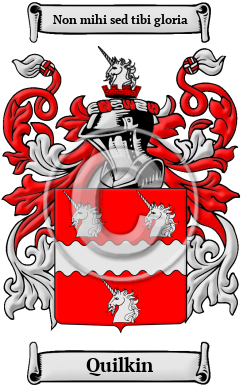
The motto was originally a war cry or slogan. Mottoes first began to be shown with arms in the 14th and 15th centuries, but were not in general use until the 17th century. Thus the oldest coats of arms generally do not include a motto. Mottoes seldom form part of the grant of arms: Under most heraldic authorities, a motto is an optional component of the coat of arms, and can be added to or changed at will; many families have chosen not to display a motto.
Motto: Non mihi sed tibi gloria
Motto Translation: Glory to thee, not to me.
- Arthur, William , An Etymological Dictionary of Family and Christian Names. London: 1857. Print
- Williams, Dr Ann. And G.H. Martin, Eds., Domesday Book A Complete Translation. London: Penguin, 1992. Print. (ISBN 0-141-00523-8)
- Guppy, Henry Brougham, Homes of Family Names in Great Britain. 1890. Print.
- Reaney, P.H and R.M. Wilson, A Dictionary of English Surnames. London: Routledge, 1991. Print. (ISBN 0-415-05737-X)
- Bardsley, C.W, A Dictionary of English and Welsh Surnames: With Special American Instances. Wiltshire: Heraldry Today, 1901. Print. (ISBN 0-900455-44-6)
- Smith, George (ed), Dictionary of National Biography. London: Smith, Elder & Co., 1885-1900. Print
- Filby, P. William, Meyer, Mary K., Passenger and immigration lists index : a guide to published arrival records of about 500,000 passengers who came to the United States and Canada in the seventeenth, eighteenth, and nineteenth centuries. 1982-1985 Cumulated Supplements in Four Volumes Detroit, Mich. : Gale Research Co., 1985, Print (ISBN 0-8103-1795-8)
 |