| ![Show Contents]() Quiley History, Family Crest & Coats of Arms Quiley History, Family Crest & Coats of Arms
- Origins Available:
Ireland
Etymology of QuileyWhat does the name Quiley mean? In Ireland, the name Quiley is generally derived from the Gaelic "Mac an Choiligh," which means "son of the cock or rooster;" the name was often Anglicized as Cox. Early Origins of the Quiley familyThe surname Quiley was first found in County Roscommon (Irish: Ros Comáin) located in central Ireland in the province of Connacht, where they held a family seat from ancient times. Early History of the Quiley familyThis web page shows only a small excerpt of our Quiley research. Another 87 words (6 lines of text) covering the years 1558, 1650, 1675, 1733, 1770 and 1837 are included under the topic Early Quiley History in all our PDF Extended History products and printed products wherever possible. Quiley Spelling VariationsDuring the Middle Ages, a standardized literary language known by the general population of Ireland was a thing of fiction. When a person's name was recorded by one of the few literate scribes, it was up that particular scribe to decide how to spell an individual's name. So a person could have several spelling variations of his name recorded during a single lifetime. Research into the name Quiley revealed many variations, including MacQuilly, McQuilly, MacQuilley, McQuilly, MacQuillie, McQuillie, Quilley, Quilly, Quillie, Cox, Coxe and many more. Early Notables of the Quiley familyAnother 38 words (3 lines of text) are included under the topic Early Quiley Notables in all our PDF Extended History products and printed products wherever possible. Migration of the Quiley familyThousands of Irish left in their homeland in the 18th and 19th centuries to escape the religious and political discrimination they experienced primarily at the hands of the English, and in the search of a plot of land to call their own. These immigrants arrived at the eastern shores of North America, early on settling and breaking the land, and, later, building the bridges, canals, and railroads essential to the emerging nations of United States and Canada. Many others would toil for low wages in the dangerous factories of the day. Although there had been a steady migration of Irish to North America over these years, the greatest influx of Irish immigrants came to North America during the Great Potato Famine of the late 1840s. Early North American immigration records have revealed a number of people bearing the Irish name Quiley or a variant listed above: William McQuillie who landed in Philadelphia, Pennsylvania in 1804; Thomas Cox, who arrived in New York, NY in 1805; Andrew Cox, who arrived in Quebec in 1850.
The motto was originally a war cry or slogan. Mottoes first began to be shown with arms in the 14th and 15th centuries, but were not in general use until the 17th century. Thus the oldest coats of arms generally do not include a motto. Mottoes seldom form part of the grant of arms: Under most heraldic authorities, a motto is an optional component of the coat of arms, and can be added to or changed at will; many families have chosen not to display a motto.
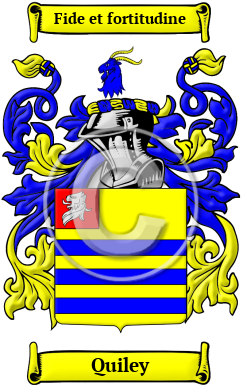
Motto: Fide et fortitudine
Motto Translation: By fidelity and fortitude.
 |