| ![Show Contents]() Quaye History, Family Crest & Coats of Arms Quaye History, Family Crest & Coats of Arms
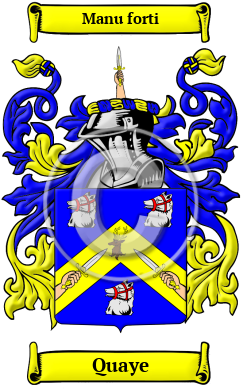
Etymology of QuayeWhat does the name Quaye mean? The name Quaye originated among the descendants of the ancient Pictish clans. It is derived from the personal name Aodh, a cognate of Hugh. The Gaelic form of the name is usually Mac Aoidh and in Inverness, the Gaelic form of the name Quaye is Mac Ai. "Nothing certain is known of the origin of the northern Mackays beyond the fact that they were early connected with Moray, and may have been a part of the ancient Clann Morgunn. The Inverness-shire Mackays are usually called in Gaelic Mac Ai, that is, MacDhai, or Davidson; they formed a branch of Clan Chattan." 1 Quaye Coat of Arms CreationWhen Queen Mary was at Inverness, Mackay of Farr disregarded her summons to appear before her. Because of this a commission was granted to the Earl of Sutherland to invade the lands of Strathnaver. He besieged Castle Borve, which was held by a small force of twenty reso-lute clansmen, but the castle was taken and demolished. (Canon were used for the first time in the North of Scotland in this siege). It is said that when Mackay was asked by the Earl of Sutherland to exhibit his charter for his lands he put his hand, clasping a dirk, upon the table and exclaimed "Lamh laidir," the Latin of which, "mane forti" (with a strong hand), has been the motto of the clan ever since. 2 Early Origins of the Quaye familyThe surname Quaye was first found in Sutherland (Gaelic: Cataibh), a former county in northern Scotland, now part of the Council Area of Highland, where early records show that Gilcrest M'Ay, forefather of the MacKay family of Ugadale, made a payment to the constable of Tarbert in 1326. It is claimed that the Clan is descended from the royal house of MacEth. Early History of the Quaye familyThis web page shows only a small excerpt of our Quaye research. Another 299 words (21 lines of text) covering the years 1329, 1408, 1411, 1429, 1506, 1575, 1640, 1689, 1692, 1726, 1873, 1890 and 1940 are included under the topic Early Quaye History in all our PDF Extended History products and printed products wherever possible. Quaye Spelling VariationsDuring the Middle Ages, there was no basic set of rules and scribes wrote according to sound. The correct spelling of Scottish names were further compromised after many haphazard translations from Gaelic to English and back. Spelling variations of the name Quaye include MacKay, MacCay, MacQuey, MacQuoid, MacKaw, MacKy, MacKye, MacCoy, McCoy and many more. Early Notables of the Quaye familyHugh Mackay (c. 1640-1692), Scottish general, Major-General Commanding in Chief in Scotland in 1689, killed at the Battle of Steinkeerke; and the infamous John Macky (died 1726), a Scottish...
Another 28 words (2 lines of text) are included under the topic Early Quaye Notables in all our PDF Extended History products and printed products wherever possible. Migration of the Quaye family to IrelandSome of the Quaye family moved to Ireland, but this topic is not covered in this excerpt.
Another 133 words (10 lines of text) about their life in Ireland is included in all our PDF Extended History products and printed products wherever possible. Migration of the Quaye familyScots left their country by the thousands to travel to Australia and North America. Desperate for freedom and an opportunity to fend for themselves, many paid huge fees and suffered under terrible conditions on long voyages. Still, for those who made the trip, freedom and opportunity awaited. In North America, many fought their old English oppressors in the American War of Independence. In recent years, Scottish heritage has been an increasingly important topic, as Clan societies and other organizations have renewed people's interest in their history. An examination of passenger and immigration lists shows many early settlers bearing the name of Quaye: Denis McCoy and his wife Catharine, who were colonists in Amelia county, Virginia in 1719; Agnes, Angus, Alexander, Anna, Catherine, Daniel, George, James, John, Margaret, Neil, Samuel and William McKay, who all arrived in Pennsylvania in 1772.
The motto was originally a war cry or slogan. Mottoes first began to be shown with arms in the 14th and 15th centuries, but were not in general use until the 17th century. Thus the oldest coats of arms generally do not include a motto. Mottoes seldom form part of the grant of arms: Under most heraldic authorities, a motto is an optional component of the coat of arms, and can be added to or changed at will; many families have chosen not to display a motto.
Motto: Manu forti
Motto Translation: With a strong hand.
War Cry: "Bratach Bhan," or White Banner.
War Cry Description: The badge of the clan is reed grass (in Gaelic cuilc)
- Black, George F., The Surnames of Scotland Their Origin, Meaning and History. New York: New York Public Library, 1946. Print. (ISBN 0-87104-172-3)
- Polson, Alexander, The Romance of Scottish Crests and Mottoes. Inverness: Walter Alexander, Inglis Street 1929. Print
 |