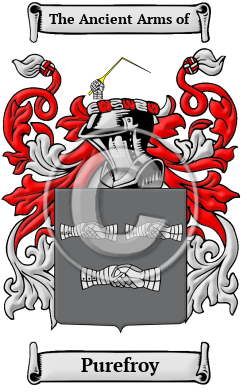
| ![Show Contents]() Purefroy History, Family Crest & Coats of Arms Purefroy History, Family Crest & Coats of Arms
Etymology of PurefroyWhat does the name Purefroy mean? The ancient Norman culture that was established in England after the Conquest of 1066 produced the name of Purefroy. It was given to a man of true faith. The name was originally derived from the Old French purefei, meaning one who was staunch and true and by my faith "The present spelling is a popular etymology, 'pure faith', which arose when per, par and pur fell together in pronunciation. " 1 Early Origins of the Purefroy familyThe surname Purefroy was first found in Staffordshire where the Feet of Fines list William Parfei in 1195 and Henry Parfei in the Assize Rolls of 1203. Later in Sussex, Robert Parfoy was listed in the Subsidy Rolls for 1296. In Warwickshire, William Purfey was listed there in the 13th century. Again in Sussex, we found Ralph Perfai in 1327 and Ralph Parfay in 1332. Later again, William Purefay was found in Leicestershire in 1412. 1 "The family were seated at Misterton, co. Leicester, in 1277. The motto borne by one branch is 'Pure foy est ma joie.'" 2 Early History of the Purefroy familyThis web page shows only a small excerpt of our Purefroy research. Another 63 words (4 lines of text) covering the years 1557, 1580, 1617, 1627, 1628, 1631, 1649 and 1659 are included under the topic Early Purefroy History in all our PDF Extended History products and printed products wherever possible. Purefroy Spelling VariationsMultitudes of spelling variations are a hallmark of Anglo Norman names. Most of these names evolved in the 11th and 12th century, in the time after the Normans introduced their own Norman French language into a country where Old and Middle English had no spelling rules and the languages of the court were French and Latin. To make matters worse, medieval scribes spelled words according to sound, so names frequently appeared differently in the various documents in which they were recorded. The name was spelled Purefoy, Purefield, Purefree, Purefrey, Purfrey, Purfry and many more. Early Notables of the Purefroy familyWilliam Purefoy (c.1580-1659) who was appointed to the High Court of Justice that tried and condemned King Charles I in 1649. He was eldest son of Francis Purefoy (d. 1617), and was elected Member of Parliament for Coventry (1627-1628) and Sheriff of Warwickshire in 1631. He joined in the signing of the death-warrant of Charles I. 3
Robert Warton...
Another 57 words (4 lines of text) are included under the topic Early Purefroy Notables in all our PDF Extended History products and printed products wherever possible. Migration of the Purefroy family to IrelandSome of the Purefroy family moved to Ireland, but this topic is not covered in this excerpt. More information about their life in Ireland is included in all our PDF Extended History products and printed products wherever possible. Migration of the Purefroy familyBecause of this political and religious unrest within English society, many people decided to immigrate to the colonies. Families left for Ireland, North America, and Australia in enormous numbers, traveling at high cost in extremely inhospitable conditions. The New World in particular was a desirable destination, but the long voyage caused many to arrive sick and starving. Those who made it, though, were welcomed by opportunities far greater than they had known at home in England. Many of these families went on to make important contributions to the emerging nations of Canada and the United States. Analysis of immigration records indicates that some of the first North American immigrants bore the name Purefroy or a variant listed above: Lieutenant Purfrey who settled in Virginia in 1623; Lucy Purefoy, who settled in Virginia in 1629; Samuell Purefoy, who came to St. Christopher (New England) in 1633.
- Reaney, P.H and R.M. Wilson, A Dictionary of English Surnames. London: Routledge, 1991. Print. (ISBN 0-415-05737-X)
- Lower, Mark Anthony, Patronymica Britannica, A Dictionary of Family Names of the United Kingdom. London: John Russel Smith, 1860. Print.
- Smith, George (ed), Dictionary of National Biography. London: Smith, Elder & Co., 1885-1900. Print
 |