| ![Show Contents]() Prink History, Family Crest & Coats of Arms Prink History, Family Crest & Coats of Arms
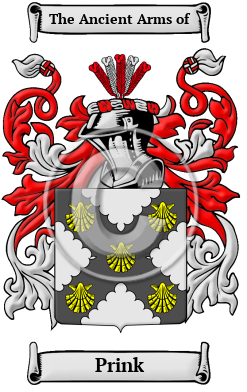
Etymology of PrinkWhat does the name Prink mean? A Boernician family in ancient Scotland were the ancestors of those who first used the name Prink. They lived in a place near Stow Roxburghshire, called Hopringle or Pringle. As such, Prink is a habitation name, a category of surnames that were derived from pre-existing names for towns, villages, parishes, or farmsteads. The place name comes from the Old English word hop which referred to an "enclosed valley," and Prjónn, an Old Norse name comprised of components which mean peg and ravine. Thus, the original bearer of the surname came from an area noted for an enclosed valley or a ravine. However some sources presume the name to be derived from "pilgrim," as "they bear in their arms the escallop shells or badges of pilgrims to the Holy Land." 1 2 Prink Coat of Arms CreationIn the works of Sir George Mackenzie, Vol. II., p. 611, it is said that Pringle of Galashiels had five golden escallops (the bi-valve scallop) in his shield, and this shell was usually worn by those who were pilgrims. Nisbet's Heraldry, published in Edinburgh in 1722, says that the first ancestor of the Pringles is said to be Pelerin, a famous pilgrim to the Holy Land, who came to Scotland, and his descendants were first called Pilgrims, and afterwards, by corruption, Pringle. The oldest family of the name is " Hop Pringle of that ilk," whose crest was a scallop, and the motto, " Amicitia reddit honores " (Friendship gives honours). King David Bruce gave the lands belonging to Walter de Pringle, forfeited, to William Pitilock Miles. One branch of the Pringles had as crest a man's heart with wings; motto, " Sursum (Upward). Another, an anchor within a garland of bay leaves; motto, " Semper spero meliora " (I always hope for better things). Every branch of the Pringles has scallop shells in its shield. 3 Early Origins of the Prink familyThe surname Prink was first found in Roxburghshire, where the first Chief on record was Robert de Hoppryngil who witnessed a deed by King Alexander III of Scotland in 1250 A.D. Forty-six years later, Ellys Obringkel was Bishop of St. Andrews, and rendered homage to King Edward I of England on his brief conquest of Scotland in 1296. His seal bore a hunting horn. About this time they acquired the Clan territories near Stow and they became close allies of the Black Douglases. 4 "The little silver coin called a pringle, formerly minted in Scotland, and of about the value of an English penny, may have derived its name from one of this family." 5 Early History of the Prink familyThis web page shows only a small excerpt of our Prink research. Another 427 words (30 lines of text) covering the years 1200, 1368, 1406, 1450, 1455, 1485, 1513, 1568, 1580, 1625, 1626, 1628, 1631, 1664, 1667, 1689, 1736 and 1976 are included under the topic Early Prink History in all our PDF Extended History products and printed products wherever possible. Prink Spelling VariationsSpelling variations occur frequently in Scottish names that date from the medieval era. They result from a general lack of grammatical rules and the tendency to spell names according to sound. Prink has been spelled Pringle, Pringell, Prindle, Hopringle and others. Early Notables of the Prink familyGeorge Pringle (1631-1689), of Torwoodlee, eldest son of James Pringle of Torwoodlee. The Pringles of Torwoodlee, Selkirkshire, are descended from the Pringles of Snailholm, Roxburghshire, the first of the name being George, son of William Pringle of Snailholm who was killed at Flodden in 1513. This George Pringle was murdered in his own house by a party of Liddesdale reivers in 1568. 6
Walter Pringle (1625-1667), of Greenknowe, Berwickshire, Scottish Covenanter, was the third son of Robert Pringle, first of Stitchel, Roxburghshire. The Pringles of Stitchel were descended from the Hop Pringles of Craiglatch and Newhall, Selkirkshire, a younger branch of the...
Another 124 words (9 lines of text) are included under the topic Early Prink Notables in all our PDF Extended History products and printed products wherever possible. Migration of the Prink family to IrelandSome of the Prink family moved to Ireland, but this topic is not covered in this excerpt.
Another 35 words (2 lines of text) about their life in Ireland is included in all our PDF Extended History products and printed products wherever possible. Migration of the Prink familyIn the 20th century, the ancestors of many of those Boernician-Scottish people still populate North America. They distributed themselves on either side of the border at the time of the War of Independence. United Empire Loyalists went north to Canada and those who wanted a new nation stayed south. Both groups went on to found great nations. Some of the first North American settlers with Prink name or one of its variants: John and William Pringle settled in Maryland in 1775; James Pringle settled in Jamaica in 1774; Capt. Pringle, 27th Regiment (Rogers Rangers) who was stationed in Ticonderoga and led an assault on Quebec in 1758. George Pringle settled in Philadelphia in 1774.
- Sims, Clifford Stanley The Origin and Signification of Scottish Surnames. 1862. Print.
- Dixon, Bernard Homer, Surnames. London: John Wilson and son, 1857. Print
- Polson, Alexander, The Romance of Scottish Crests and Mottoes. Inverness: Walter Alexander, Inglis Street 1929. Print
- Black, George F., The Surnames of Scotland Their Origin, Meaning and History. New York: New York Public Library, 1946. Print. (ISBN 0-87104-172-3)
- Lower, Mark Anthony, Patronymica Britannica, A Dictionary of Family Names of the United Kingdom. London: John Russel Smith, 1860. Print.
- Smith, George (ed), Dictionary of National Biography. London: Smith, Elder & Co., 1885-1900. Print
 |