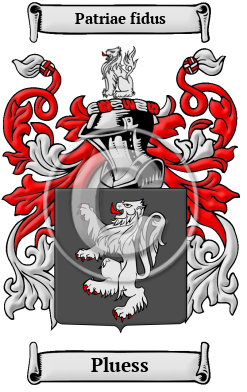
| ![Show Contents]() Pluess History, Family Crest & Coats of Arms Pluess History, Family Crest & Coats of Arms
Etymology of PluessWhat does the name Pluess mean? The proud Pluess surname is from the personal name Lewis, an Anglicized form of the Welsh name Llewellyn. This name is often explained as meaning "lion-like," but is in fact probably derived from the Welsh word "llyw," which means "leader." Alternatively, the name Lewis is also an Anglo-French form of the Old Frankish name Hludwig, which means "loud battle." Early Origins of the Pluess familyThe surname Pluess was first found in Glamorganshire (Welsh: Sir Forgannwg), a region of South Wales, anciently part of the Welsh kingdom of Glywysing, where the family held a seat from ancient times. Early History of the Pluess familyThis web page shows only a small excerpt of our Pluess research. Another 119 words (8 lines of text) covering the years 1598, 1616, 1625, 1627, 1640, 1650, 1660, 1661, 1664, 1669, 1674, 1675, 1677, 1679, 1690, 1699, 1706 and 1890 are included under the topic Early Pluess History in all our PDF Extended History products and printed products wherever possible. Pluess Spelling VariationsThere are relatively few surnames native to Wales, but they have an inordinately large number of spelling variations. Early variations of Welsh surnames can be explained by the fact that very few people in the early Middle Ages were literate. Priests and the few other literate people were responsible for recording names in official documents. And because most people could not specific how to properly record their names it was up to the individual recorder of that time to determine how a spoken name should be recorded. Variations due to the imprecise or improper recording of a name continued later in history when names originally composed in the Brythonic Celtic, language of Wales, known by natives as Cymraeg, were transliterated into English. Welsh names that were documented in English often changed dramatically since the native language of Wales, which was highly inflected, did not copy well. Occasionally, however, spelling variations were carried out according to an individual's specific design: a branch loyalty within the family, a religious adherence, or even patriotic affiliations could be indicated by minor variations. The spelling variations of the name Pluess have included Lewis, Lewiss, Lewess, Lews, Llewys, Llewis, Lewwis, Llewess and many more. Early Notables of the Pluess familySir William Lewis, 1st Baronet (1598-1677), an English politician who sat in the House of Commons between 1640 and 1677; William Lewis (1625-1661), an English landowner and politician who sat in the House of Commons in 1660; Richard Lewis (c 1627-1706), an English landowner and politician; David Lewis (1616-1679), a Welsh Catholic priest and martyr...
Another 54 words (4 lines of text) are included under the topic Early Pluess Notables in all our PDF Extended History products and printed products wherever possible. Migration of the Pluess family to IrelandSome of the Pluess family moved to Ireland, but this topic is not covered in this excerpt.
Another 57 words (4 lines of text) about their life in Ireland is included in all our PDF Extended History products and printed products wherever possible.
| Pluess migration to the United States | + |
North America in the 1800s and 1900s saw the arrival of many Welsh people hoping to share in the wealth of land, work, and freedom that they felt North America held. Those who made the journey often attained those expectations, but only through an enormous amount of hard work, perseverance, and often a bout of good luck. These immigrants helped contribute to the growth of industry, commerce, and culture of both Canada and the United States. Discovered in the immigration and passenger lists were a number of people bearing the name Pluess:
Pluess Settlers in United States in the 20th Century- Mr. Henry Pluess, (b. 1868), aged 32, Cornish labourer travelling aboard the ship "St Paul" arriving at Ellis Island, New York on 10th March 1900 en route to the United States 1
- Miss Pethick Pluess, (b. 1886), aged 17, Cornish settler, from Egloskerry, Cornwall, UK travelling aboard the ship "Cedruc" arriving at Ellis Island, New York on 20th February 1903 en route to Eagle, Wisconsin, USA 1
- Mr. William Pluess, (b. 1867), aged 36, English farmer, from Cornworthy, Devon, UK travelling aboard the ship "Cedric" arriving at Ellis Island, New York on 20th February 1903 en route to Eagle, Wisconsin, USA 1
The motto was originally a war cry or slogan. Mottoes first began to be shown with arms in the 14th and 15th centuries, but were not in general use until the 17th century. Thus the oldest coats of arms generally do not include a motto. Mottoes seldom form part of the grant of arms: Under most heraldic authorities, a motto is an optional component of the coat of arms, and can be added to or changed at will; many families have chosen not to display a motto.
Motto: Patriae fidus
Motto Translation: Faithful to my country.
- Cornwall Online Parish Clerks. (Retrieved 3rd May 2018). Retrieved from http://www.opc-cornwall.org/Resc/pdfs/emigration_ellis_island_1892_on.pdf
 |