| ![Show Contents]() Philburn History, Family Crest & Coats of Arms Philburn History, Family Crest & Coats of Arms
Etymology of PhilburnWhat does the name Philburn mean? Philburn is an ancient Norman name that arrived in England after the Norman Conquest of 1066. The Philburn family lived in Sussex, at the town of Pilbeam, which is now lost to the map. 1 Another source claims the name was derived from "A species of tree which I cannot identify, probably so named from its suitableness for the shaft of a spear; Anglo-Saxon pyl. I have not met with this name out of the county of Sussex, where it is sometimes pronounced Pilbin." 2 And another source notes the name to “barker of trees.” It is not a trade name at all, but purely local, derived from the Kent manor of Peltebeme. Possibly the peeling of trees may come into it, for the manorial landmark may have been some “peeled tree.” 3 Early Origins of the Philburn familyThe surname Philburn was first found in Sussex where Adam de Peltebhem was listed in the Subsidy Rolls of 1296. The same rolls but at a later date included Thomas Peltebem in 1327. 1 There is a presumed close relationship to the Burke family, and Philbin, which later became Pilbeam, was descended from the grandson of Richard de Burgo (Burke) Governor of Ireland in 1219 whose name was Philipin. In Ireland they were recognized as 'English' and some branches of this family adopted that name also. Others adopted the name MacPhilbin. The variant Phelippon was listed as an early Huguenot name in Ireland. (O'Hart) Meanwhile in England, the main branch Pilbeam or Philbeam, moved back to Sussex and settled there. Early History of the Philburn familyThis web page shows only a small excerpt of our Philburn research. Another 95 words (7 lines of text) covering the years 1172, 1327 and 1347 are included under the topic Early Philburn History in all our PDF Extended History products and printed products wherever possible. Philburn Spelling VariationsNorman surnames are characterized by a multitude of spelling variations. The frequent changes in surnames are largely due to the fact that the Old and Middle English languages lacked definite spelling rules. The introduction of Norman French to England, as well as the official court languages of Latin and French, also had pronounced influences on the spelling of surnames. Since medieval scribes and church officials recorded names as they sounded, rather than adhering to any specific spelling rules, it was common to find the same individual referred to with different spellings. The name has been spelled Pilbeam, Philbeam, MacPhilbin, Pilbean, Philbean, Pilbin and many more. Early Notables of the Philburn familyMore information is included under the topic Early Philburn Notables in all our PDF Extended History products and printed products wherever possible. Migration of the Philburn family to IrelandSome of the Philburn family moved to Ireland, but this topic is not covered in this excerpt.
Another 52 words (4 lines of text) about their life in Ireland is included in all our PDF Extended History products and printed products wherever possible. Migration of the Philburn familyMany English families emigrated to North American colonies in order to escape the political chaos in Britain at this time. Unfortunately, many English families made the trip to the New World under extremely harsh conditions. Overcrowding on the ships caused the majority of the immigrants to arrive diseased, famished, and destitute from the long journey across the stormy Atlantic. Despite these hardships, many of the families prospered and went on to make invaluable contributions to the development of the cultures of the United States and Canada. Early North American immigration records have revealed a number of people bearing the name Philburn or a variant listed above: Michael Philbin, who settled in Baltimore, Md, in 1834; John Pilburn, who settled in Texas in 1835; and David Pilbeam, who was recorded in the census of Ontario, Canada in 1871..
The motto was originally a war cry or slogan. Mottoes first began to be shown with arms in the 14th and 15th centuries, but were not in general use until the 17th century. Thus the oldest coats of arms generally do not include a motto. Mottoes seldom form part of the grant of arms: Under most heraldic authorities, a motto is an optional component of the coat of arms, and can be added to or changed at will; many families have chosen not to display a motto.
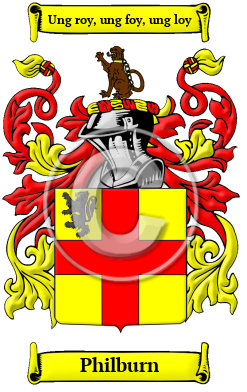
Motto: Ung roy, ung foy, ung loy
Motto Translation: One king, one faith, one law.
- Reaney, P.H and R.M. Wilson, A Dictionary of English Surnames. London: Routledge, 1991. Print. (ISBN 0-415-05737-X)
- Lower, Mark Anthony, Patronymica Britannica, A Dictionary of Family Names of the United Kingdom. London: John Russel Smith, 1860. Print.
- Smith, Eldson Coles, New Dictionary of American Family Names New York: Harper & Row, 1956. Print
 |