| ![Show Contents]() Perand History, Family Crest & Coats of Arms Perand History, Family Crest & Coats of Arms
- Origins Available:
England
Etymology of PerandWhat does the name Perand mean? The ancestors of the Perand family migrated to England following the Norman Conquest of 1066. The surname Perand is based on the ancient given name Peter which anciently meant rock or stone. "The Counts du Perrin held large possessions in the district of Nosiere, in France, but being Huguenots, the family were compelled to quit their native land, in the earlier part of the XVIII. century, and they settled in Lisburn, in Ireland. Several members of the family have distinguished themselves at the Irish bar, and one is well known as the author of an excellent grammar of his ancestral language. " 1 Early Origins of the Perand familyThe surname Perand was first found in Northumberland where Perrinus uadletus (Latin form) was listed in the Pipe Rolls of 1207. John Pirun was listed in the Pipe Rolls of Gloucestershire in 1166 and Geoffrey Perrun was listed as a Knights Templar in Lincolnshire in 1185. A few years later, Henry Piron was listed in the Curia Regis Rolls of 1194 in Oxfordshire. 2 Further to the south in Cornwall, the parish of Perran-Zabuloe is of interest to us. "St. Piran, the supposed patron of the tinners, the performer of miracles, the solitary hermit, and the Bishop of Cornwall took up his abode. 'Piran,' according to Leland, 'was born in Ireland within the province of Ostrige. Domuel was his father, and Wingela his mother. Piran was the disciple of St. Patrick. Piran came into Britain, died and was buried in Britain; and Wingela the mother of Piran inhabited in a place near her son with holy virgins.' At a period subsequent to the Norman Conquest, this manor is said to have belonged to a family called St. Piran, but whether related to the ancient saint is very uncertain." 3 Early History of the Perand familyThis web page shows only a small excerpt of our Perand research. Another 76 words (5 lines of text) covering the years 1553, 1558, 1642, 1665 and 1719 are included under the topic Early Perand History in all our PDF Extended History products and printed products wherever possible. Perand Spelling VariationsBefore English spelling was standardized a few hundred years ago, spelling variations of names were a common occurrence. Elements of Latin, Norman French and other languages became incorporated into English throughout the Middle Ages, and name spellings changed even among the literate. The variations of the surname Perand include Perrin, Perren, Perrine, Peren, Perring, Perrins and others. Early Notables of the Perand familyWilliam Peryn (died 1558), Dominican, who was probably connected with the Perins of Shropshire, prior of the Dominican house of St. Bartholomew in Smithfield in 1553. 4
Daniel Perrin (1642-1719), one of the...
Another 32 words (2 lines of text) are included under the topic Early Perand Notables in all our PDF Extended History products and printed products wherever possible. Migration of the Perand familyIn England at this time, the uncertainty of the political and religious environment of the time caused many families to board ships for distant British colonies in the hopes of finding land and opportunity, and escaping persecution. The voyages were expensive, crowded, and difficult, though, and many arrived in North America sick, starved, and destitute. Those who did make it, however, were greeted with greater opportunities and freedoms that they could have experienced at home. Many of those families went on to make important contributions to the young nations in which they settled. Early immigration records have shown some of the first Perands to arrive on North American shores: John Perryn, who came to Virginia in 1635; Arthur and Richard Perrin settled in Virginia in 1637; John Perrin settled in Virginia in 1642; Charles Perring settled in Boston in 1768.
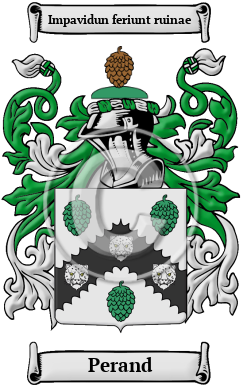
The motto was originally a war cry or slogan. Mottoes first began to be shown with arms in the 14th and 15th centuries, but were not in general use until the 17th century. Thus the oldest coats of arms generally do not include a motto. Mottoes seldom form part of the grant of arms: Under most heraldic authorities, a motto is an optional component of the coat of arms, and can be added to or changed at will; many families have chosen not to display a motto.
Motto: Impavidun feriunt ruinae
Motto Translation: Danger shall strike me unappalled.
- Lower, Mark Anthony, Patronymica Britannica, A Dictionary of Family Names of the United Kingdom. London: John Russel Smith, 1860. Print.
- Reaney, P.H and R.M. Wilson, A Dictionary of English Surnames. London: Routledge, 1991. Print. (ISBN 0-415-05737-X)
- Hutchins, Fortescue, The History of Cornwall, from the Earliest Records and Traditions to the Present Time. London: William Penaluna, 1824. Print
- Smith, George (ed), Dictionary of National Biography. London: Smith, Elder & Co., 1885-1900. Print
 |