
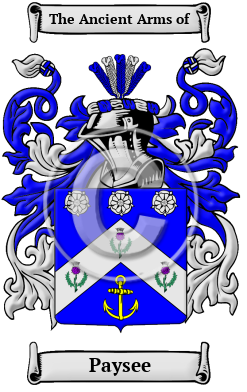
Show ContentsPaysee History, Family Crest & Coats of Arms

Etymology of Paysee

What does the name Paysee mean?

The roots of the name Paysee are found among the Strathclyde-Briton people of the ancient Scottish/English Borderlands. Paysee was originally found in the town of Paisley in Renfrew (now part of the Strathclyde region).

Early Origins of the Paysee family

The surname Paysee was first found in Renfrewshire (Gaelic: Siorrachd Rinn Friù), a historic county of Scotland, today encompassing the Council Areas of Renfrew, East Renfrewshire, and Iverclyde, in the Strathclyde region of southwestern Scotland, where they held a family seat from early times and their first records appeared on the early census rolls taken by the early Kings of Scotland to determine the rate of taxation of their subjects.

Early History of the Paysee family

This web page shows only a small excerpt of our Paysee research. Another 105 words (8 lines of text) covering the years 1179, 1199, 1202, 1320 and 1890 are included under the topic Early Paysee History in all our PDF Extended History products and printed products wherever possible.

Paysee Spelling Variations

In the era before dictionaries, there were no rules governing the spelling or translation of names or any other words. Consequently, there are an enormous number of spelling variations in Medieval Scottish names. Paysee has appeared as Paisley, Pasley and others.

Early Notables of the Paysee family

More information is included under the topic Early Paysee Notables in all our PDF Extended History products and printed products wherever possible.

Migration of the Paysee family to Ireland

Some of the Paysee family moved to Ireland, but this topic is not covered in this excerpt.
Another 71 words (5 lines of text) about their life in Ireland is included in all our PDF Extended History products and printed products wherever possible.

Migration of the Paysee family

The freedom, opportunity, and land of the North American colonies beckoned. There, Scots found a place where they were generally free from persecution and where they could go on to become important players in the birth of new nations. Some fought in the American War of Independence, while others went north to Canada as United Empire Loyalists. The ancestors of all of these Scottish settlers have been able to recover their lost national heritage in the last century through highland games and Clan societies in North America. Among them: George Paisley arrived in Philadelphia in 1853; James Paisley arrived in Charles Town [Charleston], South Carolina in 1774 with his wife and brother John.


Houseofnames.com on Facebook
