| ![Show Contents]() Pamminter History, Family Crest & Coats of Arms Pamminter History, Family Crest & Coats of Arms
- Origins Available:
England
Etymology of PamminterWhat does the name Pamminter mean? Pamminter is a name of ancient Norman origin. It arrived in England with the Norman Conquest of 1066. It is a name for a tailor. 1 2 Not all of the family moved to England as the Magni Rotuli Scaccarii Normanniae notes that John and Ranulph Parmentarius (Latin form of the name) were recorded there 1180-1195 3 Early Origins of the Pamminter familyThe surname Pamminter was first found in Leicestershire where Robert Parmenter was recorded in the Pipe Rolls of 1177. A few years later in Kent, Vmridus Parmentier was recorded in Pipe Rolls of 1198 and later again, William le Parmenter was recorded in the Curia Regis Rolls for Oxfordshire in 1204. In Worcestershire, Robert le Parminter was listed in the Assize Rolls for 1221 and in Cambridgeshire, Thomas le Parmeter was recorded c. 1250. Mancerus le Parmenter was listed in the Subsidy Rolls for Sussex in 1296. 4 The Hundredorum Rolls of 1273 included entries for: Ralphle Parmenter, Cambridgeshire; Robert Parmintre, Oxfordshire; and Walter le Parmunter, Salop (Shropshire.) 5 Early rolls in Somerset included entries for John Permonter, Somerset; Roger Permonter; and John le Permonter. All entries were noted 1 Edward III (during the first year of the reign of King Edward III.) 6 In Yorkshire, the Yorkshire Poll Tax Rolls of 1379 noted Isabella Parmeter; and Johannes Parmenter as holding lands there at that time. 5 Early History of the Pamminter familyThis web page shows only a small excerpt of our Pamminter research. Another 75 words (5 lines of text) covering the years 1200, 1275, 1658, 1671, 1676 and 1730 are included under the topic Early Pamminter History in all our PDF Extended History products and printed products wherever possible. Pamminter Spelling VariationsA multitude of spelling variations characterize Norman surnames. Many variations occurred because Old and Middle English lacked any definite spelling rules. The introduction of Norman French to England also had a pronounced effect, as did the court languages of Latin and French. Therefore, one person was often referred to by several different spellings in a single lifetime. The various spellings include Parmenter, Parminster, Parmenster, Parminter, Parmiter, Parmunter, Perminter, Parmunter, Parmintew and many more. Early Notables of the Pamminter familyJames (Jacques) Parmentier (1658-1730), painter, born in France in 1658, was nephew of the celebrated painter, Sebasté Bourdon, who encouraged and gave him instruction in drawing, and would have done more for him but for his death in 1671. After some further instruction from a relation, Parmentier came to England in September 1676, to work under J. C. De La Fosse, the decorative painter, who was then engaged in painting the ceilings at the Duke of Montagu's house in Bloomsbury, for which Parmentier laid in the dead colours. He was then sent over by William III to the royal palace at...
Another 146 words (10 lines of text) are included under the topic Early Pamminter Notables in all our PDF Extended History products and printed products wherever possible. Migration of the Pamminter familyMany English families left England, to avoid the chaos of their homeland and migrated to the many British colonies abroad. Although the conditions on the ships were extremely cramped, and some travelers arrived diseased, starving, and destitute, once in the colonies, many of the families prospered and made valuable contributions to the cultures of what would become the United States and Canada. Research into the origins of individual families in North America has revealed records of the immigration of a number of people bearing the name Pamminter or a variant listed above: John Parmiter settled in Nevis in 1663; Phillip Parmitor arrived in Boston Massachusetts in 1716; John and Robert Parmenter arrived in Boston in 1630; Nicholas Parmintew arrived in Philadelphia, Pennsylvania in 1809.
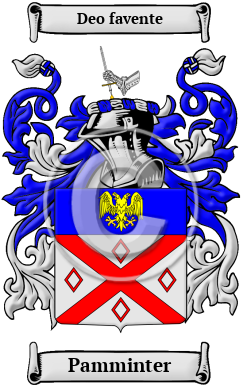
The motto was originally a war cry or slogan. Mottoes first began to be shown with arms in the 14th and 15th centuries, but were not in general use until the 17th century. Thus the oldest coats of arms generally do not include a motto. Mottoes seldom form part of the grant of arms: Under most heraldic authorities, a motto is an optional component of the coat of arms, and can be added to or changed at will; many families have chosen not to display a motto.
Motto: Deo favente
Motto Translation: By the favour of God.
- Lower, Mark Anthony, Patronymica Britannica, A Dictionary of Family Names of the United Kingdom. London: John Russel Smith, 1860. Print.
- Smith, Eldson Coles, New Dictionary of American Family Names New York: Harper & Row, 1956. Print
- The Norman People and Their Existing Descendants in the British Dominions and the United States Of America. Baltimore: Genealogical Publishing, 1975. Print. (ISBN 0-8063-0636-X)
- Reaney, P.H and R.M. Wilson, A Dictionary of English Surnames. London: Routledge, 1991. Print. (ISBN 0-415-05737-X)
- Bardsley, C.W, A Dictionary of English and Welsh Surnames: With Special American Instances. Wiltshire: Heraldry Today, 1901. Print. (ISBN 0-900455-44-6)
- Dickinson, F.H., Kirby's Quest for Somerset of 16th of Edward the 3rd London: Harrison and Sons, Printers in Ordinary to Her Majesty, St, Martin's Lane, 1889. Print.
 |