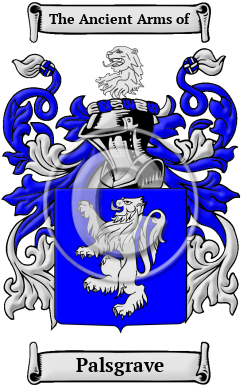
| ![Show Contents]() Palsgrave History, Family Crest & Coats of Arms Palsgrave History, Family Crest & Coats of Arms
- Origins Available:
England
Etymology of PalsgraveWhat does the name Palsgrave mean? The history of the Palsgrave family goes back to the ancient Anglo-Saxon culture of Britain. It is derived from the family living in the region of Palgrave in various counties throughout England. Palsgrave is a topographic surname, which was given to a person who resided near a physical feature such as a hill, stream, church, or type of tree. Habitation names form the other broad category of surnames that were derived from place-names. They were derived from pre-existing names for towns, villages, parishes, or farmsteads. Early Origins of the Palsgrave familyThe surname Palsgrave was first found in Suffolk at Palgrave, a village and civil parish that dates back to 962 when it was listed as Palegrave. By the Domesday Book of 1086 the village's name evolved to Palegraua which was listed there at that time. 1 The family continued to prosper in this area as the Pipe Rolls of 1199 list Osketel de Palegrave as holding lands there at that time. 2 Great Palgrave in Norfolk has a similar entry in the Domesday Book but this entry is the first listing and therefore it is presumed a more recent village. The place name literally means "grove where the poles are got" from the Old English "pal + "graf" or "grove or a man called Paga" from the Old English personal name + "graf." 3 In Essex, Stephen Palgrave was listed in the Feet of Fines for 1434. 2 Early History of the Palsgrave familyThis web page shows only a small excerpt of our Palsgrave research. Another 83 words (6 lines of text) covering the years 1480, 1525 and 1554 are included under the topic Early Palsgrave History in all our PDF Extended History products and printed products wherever possible. Palsgrave Spelling VariationsUntil quite recently, the English language has lacked a definite system of spelling rules. Consequently, Anglo-Saxon surnames are characterized by a multitude of spelling variations. Changes in Anglo-Saxon names were influenced by the evolution of the English language, as it incorporated elements of French, Latin, and other languages. Although Medieval scribes and church officials recorded names as they sounded, so it is common to find one person referred to by several different spellings of his surname, even the most literate people varied the spelling of their own names. Variations of the name Palsgrave include Palgrave, Palgrove and others. Early Notables of the Palsgrave family- John Palsgrave (c.1480-1554), an English priest of Henry VIII of England's court...
| Palsgrave migration to the United States | + |
Searching for a better life, many English families migrated to British colonies. Unfortunately, the majority of them traveled under extremely harsh conditions: overcrowding on the ships caused the majority of the immigrants to arrive diseased, famished, and destitute from the long journey across the ocean. For those families that arrived safely, modest prosperity was attainable, and many went on to make invaluable contributions to the development of the cultures of the new colonies. Research into the origins of individual families in North America revealed records of the immigration of a number of people bearing the name Palsgrave or a variant listed above:
Palsgrave Settlers in United States in the 17th Century- Mr. Richard Palsgrave of London, who arrived in Salem, Massachusetts in 1630 aboard the ship "Ambrose" as part of the Winthrop Fleet 4
- Mrs. Anne Palsgrave of London, who arrived in Salem, Massachusetts in 1630 aboard the ship "Ambrose" as part of the Winthrop Fleet 4
- Mr. John Palsgrave of London, who arrived in Salem, Massachusetts in 1630 aboard the ship "Ambrose" as part of the Winthrop Fleet 4
- Miss Anna Palsgrave of London, who arrived in Salem, Massachusetts in 1630 aboard the ship "Ambrose" as part of the Winthrop Fleet 4
- Miss Mary Palsgrave of London, who arrived in Salem, Massachusetts in 1630 aboard the ship "Ambrose" as part of the Winthrop Fleet
- ... (More are available in all our PDF Extended History products and printed products wherever possible.)
| Contemporary Notables of the name Palsgrave (post 1700) | + |
- John Palsgrave Wyllys (1754-1790), United States Army officer from Connecticut who was captured by the British during the retreat from New York during the Siege of Boston and was released the following year
- Williams, Dr Ann. And G.H. Martin, Eds., Domesday Book A Complete Translation. London: Penguin, 1992. Print. (ISBN 0-141-00523-8)
- Reaney, P.H and R.M. Wilson, A Dictionary of English Surnames. London: Routledge, 1991. Print. (ISBN 0-415-05737-X)
- Mills, A.D., Dictionary of English Place-Names. Oxford: Oxford University Press, 1991. Print. (ISBN 0-19-869156-4)
- Pilgrim Ship's of 1600's. Retrieved January 6th 2023 from https://www.packrat-pro.com/ships/shiplist.htm
 |