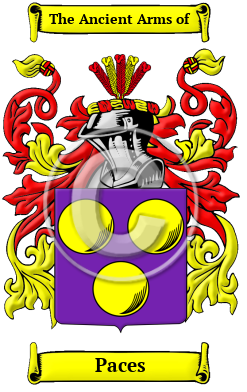
| ![Show Contents]() Paces History, Family Crest & Coats of Arms Paces History, Family Crest & Coats of Arms
- Origins Available:
England
Italy
Etymology of PacesWhat does the name Paces mean? The name Paces reached English shores for the first time with the ancestors of the Paces family as they migrated following the Norman Conquest of 1066. The Paces family lived in Cheshire. The name, however, is a reference to Pacy Sur Eure, in Evreux, Normandy, the family's place of residence prior to the Norman Conquest of England in 1066. 1 Alternatively, the name could be "given to one born during the Passover festival or at Easter; descendant of Pace (peace), or of Pace, a pet form of Bonapace (good peace)." 2 "Easter-eggs are still called pace-eggs in the North of England." 3 4 Early Origins of the Paces familyThe surname Paces was first found in Leicestershire where John Pais was listed in 1219. The Hundredorum Rolls of 1273 included: Roger and Ralph Pays in Norfolk and John Pax in Devon. Again, in Devon, John Pace was listed there in 1242. Up north, Peter Pece was found in the Subsidy Rolls for Yorkshire in 1302. 4 William Pace was listed in the Testa de Nevill and accordingly held lands at that time. 5 Early History of the Paces familyThis web page shows only a small excerpt of our Paces research. Another 107 words (8 lines of text) covering the years 1153, 1482, 1509, 1514, 1516, 1523 and 1536 are included under the topic Early Paces History in all our PDF Extended History products and printed products wherever possible. Paces Spelling VariationsAnglo-Norman names tend to be marked by an enormous number of spelling variations. This is largely due to the fact that Old and Middle English lacked any spelling rules when Norman French was introduced in the 11th century. The languages of the English courts at that time were French and Latin. These various languages mixed quite freely in the evolving social milieu. The final element of this mix is that medieval scribes spelled words according to their sounds rather than any definite rules, so a name was often spelled in as many different ways as the number of documents it appeared in. The name was spelled Pace, Paice, Pacie, Pacy and others. Early Notables of the Paces familyRichard Pace (c. 1482-1536), an English diplomat of the Tudor period. In 1509, he accompanied Cardinal Christopher Bainbridge, Archbishop of York, to Rome and remained with him until the cardinal's death by poisoning. He was instrumental in bringing the murderer to justice. He returned to England and became Cardinal Wolsey's secretary and in 1516 a Secretary of State. He was also collated Archdeacon of Dorset in 1514 a position...
Another 69 words (5 lines of text) are included under the topic Early Paces Notables in all our PDF Extended History products and printed products wherever possible.
| Paces migration to the United States | + |
Because of the political and religious discontent in England, families began to migrate abroad in enormous numbers. Faced with persecution and starvation at home, the open frontiers and generally less oppressive social environment of the New World seemed tantalizing indeed to many English people. The trip was difficult, and not all made it unscathed, but many of those who did get to Canada and the United States made important contributions to the young nations in which they settled. Some of the first North American settlers with Paces name or one of its variants:
Paces Settlers in United States in the 19th Century- Anto Paces, aged 25, who arrived in New Orleans, La in 1841 6
- The Norman People and Their Existing Descendants in the British Dominions and the United States Of America. Baltimore: Genealogical Publishing, 1975. Print. (ISBN 0-8063-0636-X)
- Smith, Eldson Coles, New Dictionary of American Family Names New York: Harper & Row, 1956. Print
- Harrison, Henry, Surnames of the United Kingdom: A Concise Etymological Dictionary Baltimore: Geneological Publishing Company, 2013. Print
- Reaney, P.H and R.M. Wilson, A Dictionary of English Surnames. London: Routledge, 1991. Print. (ISBN 0-415-05737-X)
- Testa de Nevill or "Liber Feodorum" or "Book of Fees," thought to have been written by Ralph de Nevill, for King John (1199–1216)
- Filby, P. William, Meyer, Mary K., Passenger and immigration lists index : a guide to published arrival records of about 500,000 passengers who came to the United States and Canada in the seventeenth, eighteenth, and nineteenth centuries. 1982-1985 Cumulated Supplements in Four Volumes Detroit, Mich. : Gale Research Co., 1985, Print (ISBN 0-8103-1795-8)
 |