| ![Show Contents]() Ostien History, Family Crest & Coats of Arms Ostien History, Family Crest & Coats of Arms
- Origins Available:
Scotland
Ireland
Etymology of OstienWhat does the name Ostien mean? The ancient Strathclyde Briton name Ostien is derived from the Gaelic Mac Austain meaning "son of Austin." Early Origins of the Ostien familyThe surname Ostien was first found in Scotland where "the Austins appear first on record as allies and supporters of the Keiths. The name was variously spelt, though in ancient records it was generally begun with Ou or Ow. Of curious interest as showing an early connection between the families is the occurrence in 1587 of the name of Alexander Ousteane, burgess of Edinburgh, as one of the cautioners for George Keith, Earl Marshall, in an action raised against him, by Margaret Erskine, Lady Pitcarie. In the same year Alexander Oisteane, no doubt the same person, was a parliamentary representative of the Burgh of Edinburgh. In 1589 Walter Oustene, a tenant in Lochquhan (a possession of the Keith family), was one of the subscribers to a Bond of Caution imposed on a number of the landed men in the shires of Aberdeen and Kincardine, binding them to keep the peace in the struggles with the Catholic party beaded by Huntly" (D. W. Stewart, Old and rare Scottish tartans). " 1 Early History of the Ostien familyThis web page shows only a small excerpt of our Ostien research. Another 151 words (11 lines of text) covering the years 1376, 1448, 1503, 1566, 1574, 1583, 1584, 1593, 1594, 1676, 1681, 1699, 1755, 1800, 1820 and 1890 are included under the topic Early Ostien History in all our PDF Extended History products and printed products wherever possible. Ostien Spelling VariationsScribes in Medieval Scotland spelled names by sound rather than any set of rules, so an enormous number of spelling variations exist in names of that era. Ostien has been spelled Austin, Austins, Austen, Austeane, Ostian, Ousteane, Owstyne, Ostiane and many more. Early Notables of the Ostien familyJohn Austin (fl. 1820), a Scotch inventor and native of Craigton. He published at Glasgow, in or about 1800, a system of 'Stenography which may be learned in an hour,' on a single folio engraved sheet, price 2s. 6d. A note at the end announces the publication of a complete system by the same author, price one guinea, but this does not appear to...
Another 64 words (5 lines of text) are included under the topic Early Ostien Notables in all our PDF Extended History products and printed products wherever possible. Migration of the Ostien family to IrelandSome of the Ostien family moved to Ireland, but this topic is not covered in this excerpt.
Another 58 words (4 lines of text) about their life in Ireland is included in all our PDF Extended History products and printed products wherever possible.
| Ostien migration to the United States | + |
The number of Strathclyde Clan families sailing for North America increased steadily as the persecution continued. In the colonies, they could find not only freedom from the iron hand of the English government, but land to settle on. The American War of Independence allowed many of these settlers to prove their independence, while some chose to go to Canada as United Empire Loyalists. Scots played essential roles in the forging of both great nations. Among them:
Ostien Settlers in United States in the 19th Century- Henry Ostien, who arrived in Allegany (Allegheny) County, Pennsylvania in 1868 2
The motto was originally a war cry or slogan. Mottoes first began to be shown with arms in the 14th and 15th centuries, but were not in general use until the 17th century. Thus the oldest coats of arms generally do not include a motto. Mottoes seldom form part of the grant of arms: Under most heraldic authorities, a motto is an optional component of the coat of arms, and can be added to or changed at will; many families have chosen not to display a motto.
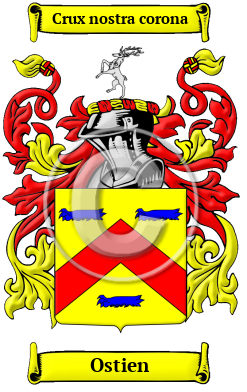
Motto: Crux nostra corona
Motto Translation: The cross is our crown.
- Black, George F., The Surnames of Scotland Their Origin, Meaning and History. New York: New York Public Library, 1946. Print. (ISBN 0-87104-172-3)
- Filby, P. William, Meyer, Mary K., Passenger and immigration lists index : a guide to published arrival records of about 500,000 passengers who came to the United States and Canada in the seventeenth, eighteenth, and nineteenth centuries. 1982-1985 Cumulated Supplements in Four Volumes Detroit, Mich. : Gale Research Co., 1985, Print (ISBN 0-8103-1795-8)
 |