
Show ContentsO'Horoe History, Family Crest & Coats of Arms

Etymology of O'Horoe

What does the name O'Horoe mean?

Irish surnames are linked to the long Gaelic heritage of the Island nation. The original Gaelic form of the name O'Horoe is Ó hEaghra, connoting a descendant of Eaghra. O'Horoe is a patronymic surname, which derived from the vernacular given name tradition.

Early Origins of the O'Horoe family

The surname O'Horoe was first found in County Sligo (Irish: Sligeach), in the province of Connacht in Northwestern Ireland, where they held a family seat from ancient times.

Early History of the O'Horoe family

This web page shows only a small excerpt of our O'Horoe research. Another 111 words (8 lines of text) are included under the topic Early O'Horoe History in all our PDF Extended History products and printed products wherever possible.

O'Horoe Spelling Variations

During the Middle Ages, scribes listened to a person's name and then decided the spelling from there. Names, therefore, often had many spelling variations. The variations of the name O'Horoe include: Hara, Harra, O'Hara and others.

Early Notables of the O'Horoe family

More information is included under the topic Early O'Horoe Notables in all our PDF Extended History products and printed products wherever possible.

Migration of the O'Horoe family

Irish immigrants began to leave the English-controlled Ireland in sizable numbers during the late 18th century. Many of these Irish immigrated to British North America or the United States in the hopes of gaining their own tract of farmland. This pattern of migration grew steadily until the 1840s when the Great Potato Famine caused a great exodus of immigrants to North America. These immigrants differed from their predecessors in that they were desperately fleeing the disease and starvation that plagued their homeland, and many were entirely destitute when they arrived in North America. Although these penniless immigrants were not warmly welcomed when they arrived, they were critical to the rapid development of the United States and what would become known as Canada. Many went to populate the western frontiers and others provided the cheap labor the new manufacturing sector and the building of bridges, roads, railways, and canals required. A thorough examination of immigration and passenger lists has revealed some of the earliest people to arrive in North America with name O'Horoe or one of its variants: Charles O'Hara, who came to Boston in 1716; Ann O'Hara, an English convict sent to Rappahannock, Virginia in 1740; David O'Hara, who was naturalized in Charles Town [Charleston], South Carolina in 1783.


The O'Horoe Motto +

The motto was originally a war cry or slogan. Mottoes first began to be shown with arms in the 14th and 15th centuries, but were not in general use until the 17th century. Thus the oldest coats of arms generally do not include a motto. Mottoes seldom form part of the grant of arms: Under most heraldic authorities, a motto is an optional component of the coat of arms, and can be added to or changed at will; many families have chosen not to display a motto.

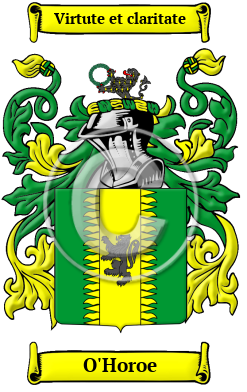
Motto: Virtute et claritate
Motto Translation: By virtue and high repute.


Houseofnames.com on Facebook