| ![Show Contents]() Nisbit History, Family Crest & Coats of Arms Nisbit History, Family Crest & Coats of Arms
- Origins Available:
Scotland
Ireland
Etymology of NisbitWhat does the name Nisbit mean? A Boernician family in ancient Scotland were the ancestors of those who first used the name Nisbit. They lived in any of several places in the Border region of Scotland called Nesbitt or Nisbit. There were hamlets of East Nisbet and West Nisbet in Berwickshire, a village of Nisbet in Roxburghshire, a Nesbit in Northumberland, and a township of Nesbit in County Durham. 1 These place names derive from the Middle English words nese, meaning "nose," and bit, meaning a "piece of ground;" as such, these place names are thought to have referred to geographic features resembling a nose. The surname may well have arisen independently from these different place names. Early Origins of the Nisbit familyThe surname Nisbit was first found in Berwickshire an ancient county of Scotland, presently part of the Scottish Borders Council Area, located in the eastern part of the Borders Region of Scotland where they held a family seat from early times and King David I confirmed a charter (now in the archives of Durham Cathedral) granting the lands of Nisbet to Aldan de Nisbet, the founder of the line of Nisbet in 1139. According to family lore, they descend from Gospatric, Earl of Northumbria (d. 1073). The family is "from the old barony of Nesbit in the parish of Edrom, Berwickshire. William de Nesebite witnessed a confirmation of the town lands of Nesbite to the Priory of Coldingham by Patrick, first Earl of Dunbar (Raine, 116), Dominus Robert de Nesbit, miles, witnessed a charter by William de Horuirden to the Abbey of Kelso, c. 1160-1200." 2 Early History of the Nisbit familyThis web page shows only a small excerpt of our Nisbit research. Another 308 words (22 lines of text) covering the years 1255, 1296, 1340, 1433, 1446, 1456, 1493, 1559, 1580, 1594, 1605, 1609, 1625, 1627, 1630, 1632, 1641, 1657, 1660, 1664, 1677, 1685, 1687, 1725 and 1890 are included under the topic Early Nisbit History in all our PDF Extended History products and printed products wherever possible. Nisbit Spelling VariationsSpelling variations occur frequently in Scottish names that date from the medieval era. They result from a general lack of grammatical rules and the tendency to spell names according to sound. Nisbit has been spelled Nisbet, Nysbit, Nispett, Nispet, Nisbit, Nisbett, Nessbitt, Nessbit, Nesbyth, Nesbitt, Naibet, Nesbeth, Nesbet, Naisbitt, Naisbit, Nesbett, Naisbett, Naibett and many more. Early Notables of the Nisbit familyMurdoch Nisbet (d. 1559) of Ayrshire, a notary public in the diocese of Glasgow, best known for his Scots translations of the Bible.
Philip Nesbit, of that Ilk was knighted in March 1605 by the Earl of Dunfermline, Lord Chancellor of Scotland; he represented Berwickshire in the Scottish parliament from 1625.
John Nisbet (1627-1685), was a...
Another 53 words (4 lines of text) are included under the topic Early Nisbit Notables in all our PDF Extended History products and printed products wherever possible. Migration of the Nisbit family to IrelandSome of the Nisbit family moved to Ireland, but this topic is not covered in this excerpt.
Another 92 words (7 lines of text) about their life in Ireland is included in all our PDF Extended History products and printed products wherever possible.
| Nisbit migration to the United States | + |
In the 20th century, the ancestors of many of those Boernician-Scottish people still populate North America. They distributed themselves on either side of the border at the time of the War of Independence. United Empire Loyalists went north to Canada and those who wanted a new nation stayed south. Both groups went on to found great nations. Some of the first North American settlers with Nisbit name or one of its variants:
Nisbit Settlers in United States in the 19th Century- Alexander Nisbit, who arrived in New York in 1835 3
- George Rae Nisbit, who landed in New York in 1835 3
- James Nisbit, who arrived in New York in 1839 3
- Joseph Nisbit, who landed in New York in 1839 3
| Nisbit migration to New Zealand | + |
Emigration to New Zealand followed in the footsteps of the European explorers, such as Captain Cook (1769-70): first came sealers, whalers, missionaries, and traders. By 1838, the British New Zealand Company had begun buying land from the Maori tribes, and selling it to settlers, and, after the Treaty of Waitangi in 1840, many British families set out on the arduous six month journey from Britain to Aotearoa to start a new life. Early immigrants include: Nisbit Settlers in New Zealand in the 19th Century- Mary Nisbit, who arrived in Auckland, New Zealand aboard the ship "Telegraph" in 1863
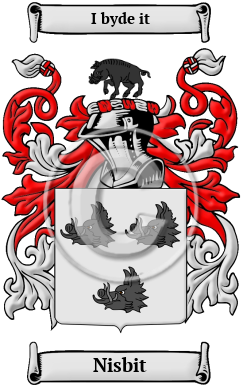
The motto was originally a war cry or slogan. Mottoes first began to be shown with arms in the 14th and 15th centuries, but were not in general use until the 17th century. Thus the oldest coats of arms generally do not include a motto. Mottoes seldom form part of the grant of arms: Under most heraldic authorities, a motto is an optional component of the coat of arms, and can be added to or changed at will; many families have chosen not to display a motto.
Motto: I byde it
- Lower, Mark Anthony, Patronymica Britannica, A Dictionary of Family Names of the United Kingdom. London: John Russel Smith, 1860. Print.
- Black, George F., The Surnames of Scotland Their Origin, Meaning and History. New York: New York Public Library, 1946. Print. (ISBN 0-87104-172-3)
- Filby, P. William, Meyer, Mary K., Passenger and immigration lists index : a guide to published arrival records of about 500,000 passengers who came to the United States and Canada in the seventeenth, eighteenth, and nineteenth centuries. 1982-1985 Cumulated Supplements in Four Volumes Detroit, Mich. : Gale Research Co., 1985, Print (ISBN 0-8103-1795-8)
 |